Market's dipped a bit on Wednesday after digesting the Supreme Court's tariff pause.
U.S. Secretary Bessent says the U.S. is prepared to pay back companies for the tariffs they received, if needed.
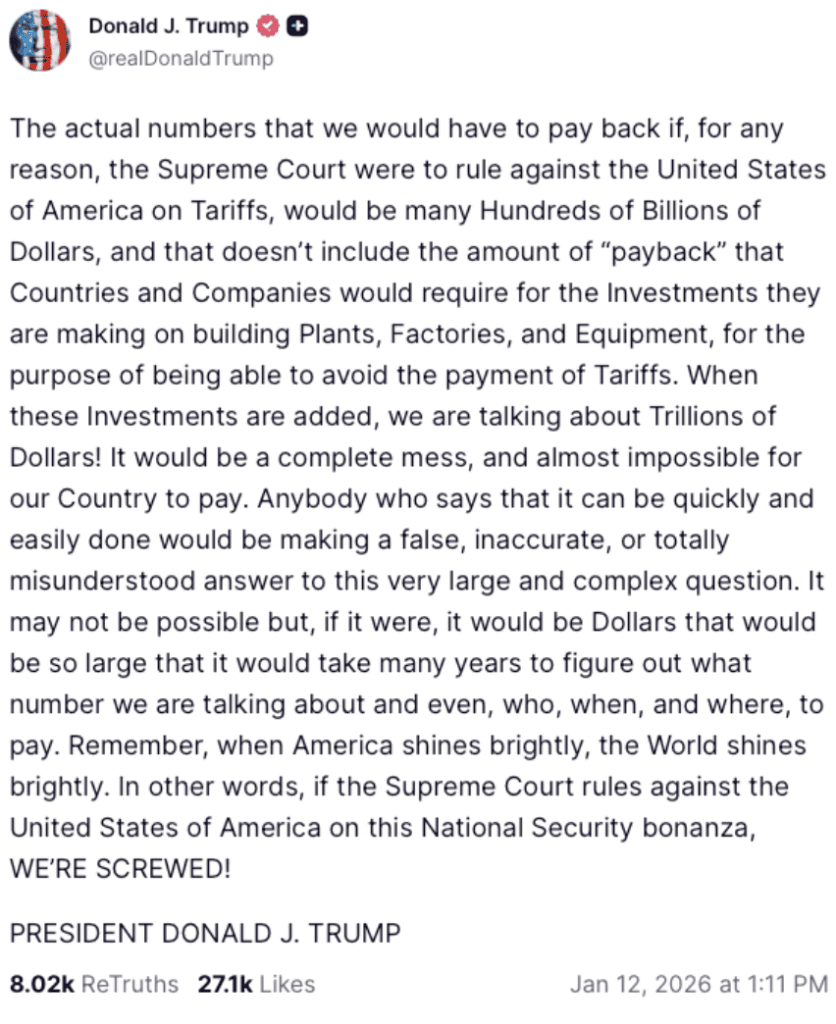
President Trump said the tariffs were a success and a ruling against them would mean the U.S. is 'screwed.'
Markets held their breath Wednesday morning as investors awaited a Supreme Court decision on the Trump administration's tariff policy - a decision that never came.
The court handed down three decisions on Wednesday, and tariffs were not among them.
A verdict from the highest court in the land has been looming over much of the market, as many companies are looking to plan out their shipping and freight orders for Q2 and Q3 of 2026.
The freight industry itself has faced significant struggles in the face of the tariffs, with many companies loading up on goods before the tariffs hit, triggering a destocking event.
The Tariffs, which were implemented using the International Emergency Economic Powers Act, have been challenged by many of the impacted companies as an illegal tax, and an overreach of presidential authority.
If the supreme court does rule them as illegal, it could trigger widespread refunds to companies that have been paying the cost.
National Economic Council Director, Kevin Hassett, said that the White House is creating a contingency plan if that happens, telling CNBC’s Squawk on the Street:
“There was a big call last night with all the principals to talk about if the Supreme Court were to rule against this IEEPA tariff, what would the next step be? “
U.S. Treasury Secretary, Scott Bessent, also displayed confidence, saying “It won't be a problem if we have to do it.”
President Trump himself did not echo that same confidence, taking to his social media to say that if the Supreme Court were to rule against the tariffs “we’re screwed!”
Trump has been championing the tariffs as the major reason for a strong U.S. economy, saying his tariff policy has generated $18 trillion in U.S. investment.
On Tuesday, January 14th the President spoke to the Detroit Economic Club, saying “one of the biggest reasons for this unbelievable success has been our historic use of tariffs.”
While some analysts have questioned the validity of the $18 trillion dollar claim, U.S. markets have shown a strong start to 2026, hovering around record highs.
However, markets began to slip on Wednesday after news broke that the Court’s decision had been delayed, with the S&P 500 down more than 1% by 12:00 PM EST.
Briefs Finance analyst Jackson Moreland said the losses are expected, describing a market on-edge:
“The court’s decision is looming over a big portion of the American economy. It’s not just freight, this ruling will set the tone for retail, luxury, even industries like energy. Right now, there’s an air of uncertainty, and investors are frozen”
Not everything is down in the face of the Court’s delayed decision, as precious metals are on the rise, with both Gold and Silver showing gains.
Younger investors should hold mostly stocks because they have decades to recover from crashes and benefit from compounding.
Allocations gradually shift toward bonds and stable income as retirement approaches, but stocks remain important even past age 65 to outpace inflation.
Annual rebalancing is essential - it forces you to buy low and sell high while keeping your portfolio aligned with your actual life stage.
Stablecoins are cryptocurrencies pegged to stable assets like the US dollar, giving crypto-style speed and access without the volatility of Bitcoin or Ethereum.
Fiat-backed stablecoins like USDC are the safest option, while algorithmic stablecoins have failed spectacularly and should generally be avoided.
Stablecoins fit a portfolio as cash reserves with better yields, a hedge against crypto volatility, and a fast, cheap rail for international transactions.
Buy now, pay later services like Klarna, Affirm, and Sezzle are debt products designed to feel harmless while keeping users in a cycle of overspending.
BNPL exploits psychological debt blindness, triggers late fees, and damages credit scores without helping users build positive credit history.
Building real wealth means waiting 30 days, paying upfront when you have the cash, and avoiding systems built to extract money from your future income.
BRRRR stands for Buy, Rehab, Rent, Refinance, Repeat - a five-step framework for scaling real estate without saving for big down payments.
The strategy works by buying distressed properties below market value, adding value through smart renovations, and pulling out equity through refinancing.
Tax advantages like depreciation and mortgage interest deductions make BRRRR a powerful tool for owners willing to manage tenants and contractors.