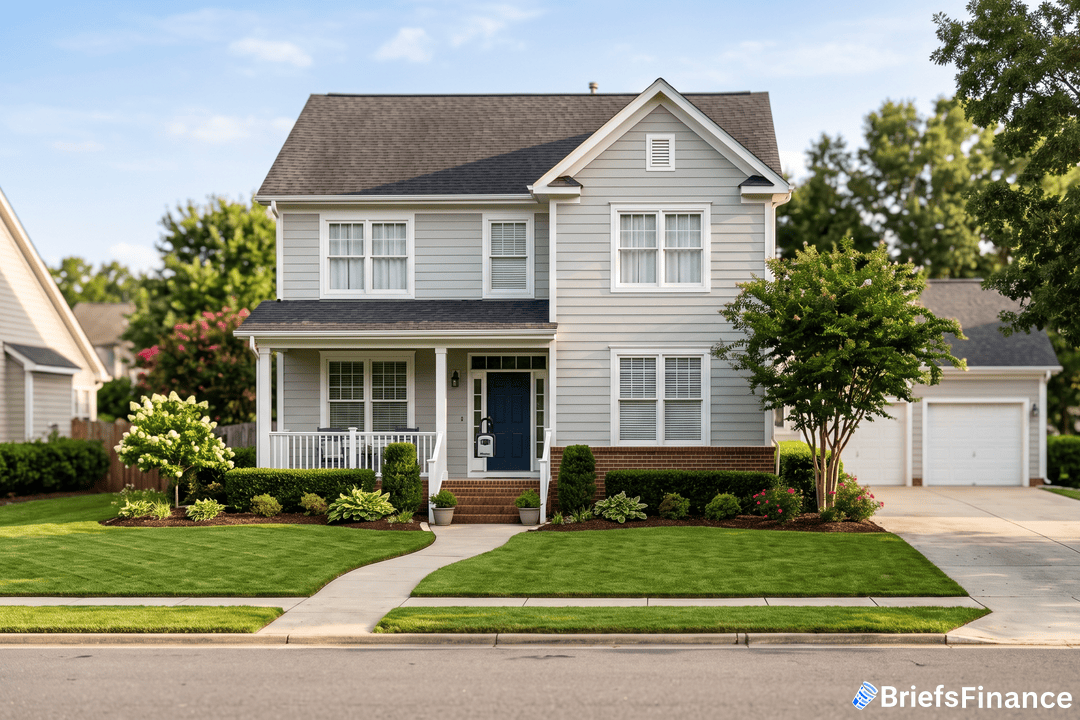

If you've scrolled through real estate investing content, you've probably seen the acronym BRRRR thrown around like it's a secret code. It sounds mysterious. It looks like someone sneezed while typing. But it's actually one of the most practical frameworks for building real estate wealth - especially if you don't have a massive down payment sitting in the bank.
Here's what makes BRRRR different: most people think real estate investing requires you to already be rich. But the BRRRR strategy shows you how to use leverage, creativity, and the equity you build to keep scaling your portfolio.
Real estate is one slice of the financial world - but mortgage rates, housing trends, and the broader economy all affect your next BRRRR deal. Market Briefs is a free daily newsletter that keeps you up to speed on all of it in a quick morning read. Join 300,000+ readers who never miss what's moving the markets.
What Does BRRRR Strategy Stand For in Real Estate?
B = Buy R = Rehab (repair/renovate) R = Rent (lease it out to tenants) R = Refinance (pull equity out) R = Repeat (scale the model)
That's the whole BRRRR strategy in five letters. But the execution is where it gets interesting.
Step 1: Buy Undervalued Properties (The BRRRR Strategy Foundation)
The key to BRRRR is buying below market value.
Most people buy properties at market price. You buy distressed properties - places that need work, are in transition, or the owner needs to sell quickly.
How do you find these deals?
- Wholesale lists (wholesalers contract properties below market, then assign to investors)
- Foreclosure auctions
- For-sale-by-owner properties (no realtor commission, so flexibility on price)
- Properties in transition neighborhoods with potential
- Homes where the owner is relocating and just wants it gone
Your goal: Buy at 20-40% below the property's after-repair value (ARV).
Example: A house is worth $500,000 in perfect condition (ARV = $500k). You buy it for $300,000 because it needs work. That's your 40% discount.
Step 2: Rehab Properties (The BRRRR Value Add Phase)
You don't need to do the renovation yourself. You hire contractors.
The key is keeping rehab costs reasonable and actually increasing the property's value. A $200,000 kitchen remodel doesn't make sense. A $40,000 smart rehab that increases value by $100,000 does.
This is where real estate investors make or lose money. Underestimate costs, and you're underwater. Overspend on fancy upgrades, and your return vanishes.
Smart investors in Climb to Wealth understand that every dollar spent should add more than a dollar in value. If you spend $100k on repairs, the property should be worth at least $150k more.
Step 3: Rent Out Properties (Building Passive Income with BRRRR)
Once the property is fixed up, you lease it to tenants.
Now the property is generating monthly cash flow. That rent payment is coming in whether you're working or sleeping.
This is where the wealth actually builds. You're not relying on the property appreciating in value. You're getting paid every month by someone else living in your asset.
The rent needs to cover:
- Your mortgage payment
- Property taxes
- Insurance
- Maintenance reserves (usually 5-10% of rent)
- Property management (if you hire it out)
- Vacancy reserves (when the unit sits empty between tenants)
If rent covers all of this plus puts money in your pocket, you've got a winner.
Step 4: Refinance Properties (Pulling Equity Out with BRRRR)
Here's where BRRRR strategy gets interesting.
Let's go back to your example:
- You bought for $300,000
- You renovated for $80,000 (total invested: $380,000)
- The property is now worth $500,000 (after-repair value)
You've built $120,000 in equity ($500k value - $380k invested).
Now you refinance. A lender looks at the property. It's worth $500,000. You owe $300,000 on the original mortgage. They'll refinance you for $400,000 (80% of the new value).
You take that $400,000, pay off the $300,000 mortgage, and pocket $100,000 in cash.
You've now pulled out nearly everything you invested, and you still own the property generating rental income.
Step 5: Repeat the BRRRR Strategy (Scaling Your Portfolio)
Now you have $100,000 in cash to deploy on your next deal.
You find another distressed property. Buy it. Rehab it. Rent it. Refinance it. Pull cash out. Start again.
Each cycle, you're building more income-producing assets without waiting to save $50,000 out of your paycheck.
This is the scaling mechanism. This is how real estate investors build 10, 20, or 50 properties while most people are still working toward their first house.
The BRRRR Mindset: From Consumer to Owner
According to the Climb to Wealth framework, the difference between being broke and being wealthy comes down to whether you're a consumer or an owner.
Most people consume: they buy a house to live in, they rent apartments, they spend all their income.
BRRRR investors think like owners: they buy properties to generate income, they rent properties to others, they reinvest their profits into more assets.
One person is paying a landlord or a mortgage. Another person is receiving those payments from tenants.
Guess who builds wealth?
The Risks (Real Talk)
BRRRR isn't a get-rich-quick scheme. It's a get-rich-slow scheme that actually works.
Real risks:
- Contractor costs overrun: Renovations always cost more than expected
- Vacancy risk: If tenants leave, you're covering the mortgage yourself
- Market risk: Property values can fall, leaving you underwater
- Interest rate risk: If rates spike, refinancing becomes harder or more expensive
- Tenant risk: Bad tenants damage properties or don't pay rent
This is why smart investors diversify across multiple properties - one vacancy doesn't kill their cash flow.
The Hidden Advantage: Tax Benefits
Real estate has massive tax advantages that stocks and bonds don't offer.
When you own a rental property, you can deduct:
- Mortgage interest (huge in early years)
- Property taxes
- Insurance
- Repairs and maintenance
- Depreciation (a tax deduction even if the property appreciates)
These deductions often reduce your taxable income significantly. In some cases, investors with substantial rental income actually pay little to no income taxes because of depreciation and other deductions.
This aligns with the fundamental principle from Climb to Wealth: your economic system rewards owners, not just workers. The tax code is written to encourage capital deployment and asset ownership - a key part of protecting your wealth.
Is BRRRR Right for You?
BRRRR requires:
- Capital to invest (even if small)
- Time to manage the process
- Risk tolerance
- Understanding of real estate and markets
- Access to financing
It's not a strategy for someone who wants completely passive investments. You're actively buying, renovating, managing, and refinancing.
But if you're willing to put in the work, BRRRR is one of the most powerful wealth-building frameworks available to regular investors.
Getting Started with BRRRR
- Educate yourself on your local real estate market
- Network with other investors to find deals and learn from their mistakes
- Find a mortgage broker who understands investment properties
- Start small with one property to understand the process
- Learn contractor management or hire a project manager
- Track every expense for tax and refinancing purposes
The first BRRRR deal is the hardest. By the third or fourth, the process becomes familiar and replicable.
Smart real estate investors stay plugged into what's happening in the broader economy - rate moves, housing data, and beyond. Market Briefs delivers the day's biggest business and finance stories every morning, free. It's the easiest way to stay sharp.
Disclaimer: This content is for educational purposes only. Real estate investing carries significant risk. Consult with a real estate attorney, tax professional, and financial advisor before implementing any strategy.