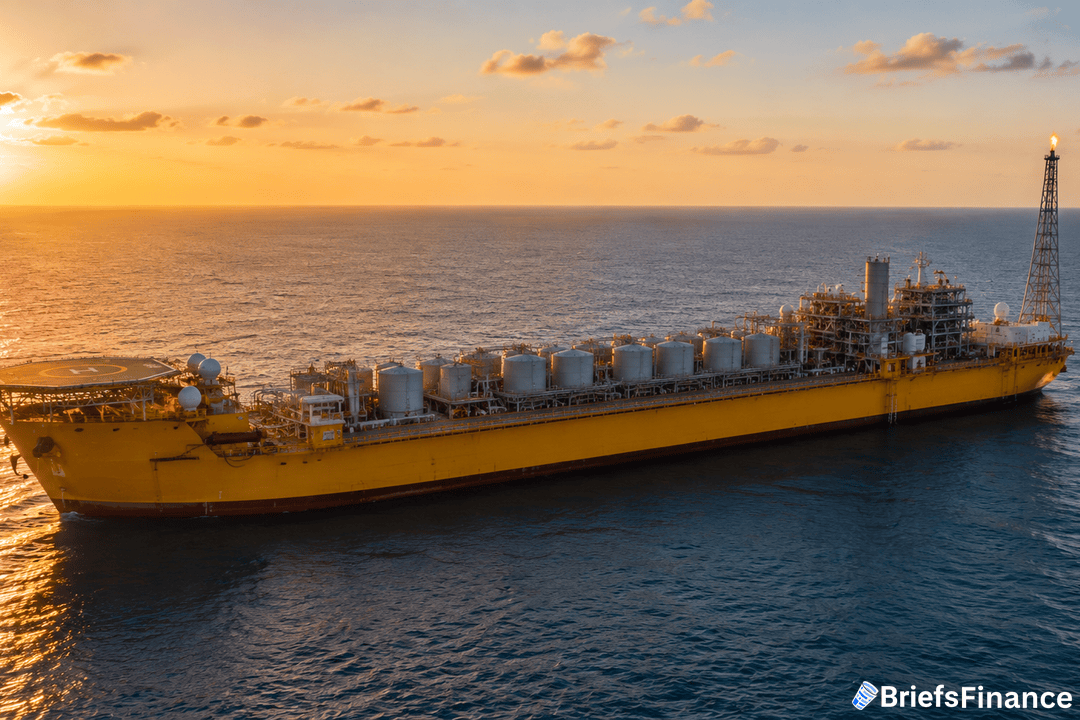
Africa keeps getting bigger on the global oil map. Italy's Eni just made it bigger again.
The company greenlit a $4 billion expansion of its Baleine offshore project in Ivory Coast on Monday, alongside partners Vitol and state oil company Petroci. The third phase will more than double oil output while lifting gas production at the same time.
What The $4 Billion Buys
Phase 3 is built around a new floating production, storage and offloading vessel - basically a giant ship that pumps, processes, and stores crude offshore so tankers can pick it up.
The project is built to take Baleine's oil output from 60,000 barrels a day up to 150,000.
Gas climbs from 80 million cubic feet a day to 200 million, with first oil from Phase 3 expected in 32 to 36 months.
All gas produced will go to Ivory Coast's domestic market - a strategic move that gives Eni a long runway with the government and feeds power generation in a country that's been short on stable electricity.
If you want a daily five-minute read on the deals moving energy markets, join Market Briefs - you also get a free investing masterclass when you sign up.
Why Ivory Coast, Why Now
Baleine is Ivory Coast's largest hydrocarbon discovery ever, and Eni has been in the country since 2015 - long enough to also make a second big find called Calao.
The government has been pushing Eni to bring forward full output to monetize the resource faster, which is part of why Phase 3 moved off the drawing board now.
The timing is interesting because oil dropped more than 5% Monday on hopes that the Strait of Hormuz reopens and Iran nuclear talks make progress. A big new Africa project is exactly the kind of long-cycle bet that pays off if global crude supply tightens again later this decade.
Think of it like building a backup generator. You don't need it most days, but when the lights go out, you want it already wired up.
What To Watch
The 32 to 36 month timeline matters, because Eni is targeting first oil from Phase 3 sometime in 2029 - a window where global supply is set to tighten as OPEC spare capacity shrinks and U.S. shale growth slows.
For investors, the wider read is on majors expanding in West Africa. TotalEnergies, BP, and Equinor have all been growing footprints in the region in different ways, with Eni the most aggressive of the group on Ivory Coast specifically.
BofA recently called $90 Brent the best case for oil this year, so long-cycle Africa projects look smart on a supply-tightening view of 2027 and beyond.
The next checkpoint is the FPSO contract award and construction start. Until then, it's a $4 billion idea with a final investment decision behind it.
Get Market Briefs in your inbox every weekday morning - plus a free 45-minute investing course as a bonus.