Free NewsletterPro Login
S&P 500 6,287 +0.42%
DOW 44,521 -0.18%
NASDAQ 21,103 +0.71%
S&P 500 +12.4%
Briefs Finance Fund +24.8%
JOIN THE FUND →

A Super El Nino Could Collide With the Iran War to Create a Global Food Crisis

Published Apr 9, 2026
Listen to this article 2 min read
Share:
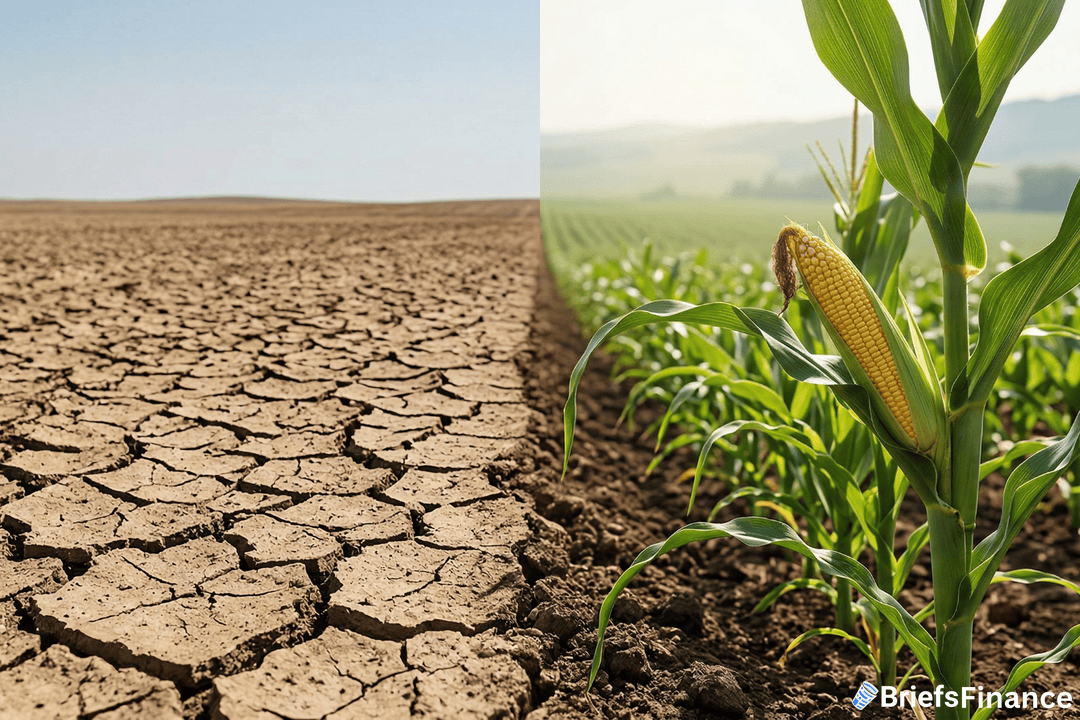
A split image showing dry, cracked soil on the left and healthy green corn growing in fertile soil on the right, illustrating a contrast in agricultural conditions.
Summary:
  • U.S. meteorologists estimate a 1-in-3 chance of a "strong" El Nino forming between October and December 2026, with European models suggesting even higher odds of a "super" event.
  • The Iran war has disrupted roughly one-third of the world's seaborne fertilizer trade through the Strait of Hormuz, right as the US planting season begins.
  • The World Food Programme warns acute hunger could jump by 45 million people if the conflict persists beyond June and oil stays above $100 per barrel.

The world's food supply is getting squeezed from two directions at once. A powerful weather pattern may develop later this year, while the Iran war is already choking off fertilizer shipments.

Together, they could trigger a food crisis affecting hundreds of millions of people. The math is sobering: 318 million people are already food insecure globally.

The El Nino Wildcard

El Nino is a warming pattern in the tropical Pacific that shifts weather worldwide.

When it hits, it typically pushes cocoa, food oils, rice, and sugar prices higher by disrupting growing conditions from Southeast Asia to South America. U.S. meteorologists estimate a 1-in-3 chance of a "strong" El Nino forming between October and December.

European models put the probability even higher, with some suggesting a "super El Nino" - an exceptionally powerful version.

Paul Donovan, chief economist at UBS, warned: "2026 might produce a super El Nino weather pattern. In that case, drought and limited water supply might be more important than shortages of nitrogen."

The Fertilizer Crunch

About one-third of all seaborne fertilizer trade normally passes through the Strait of Hormuz.

Since the blockade began on Feb 28, that shipping has virtually stopped.

Fertilizer is to modern farming what gas is to a car - no supply, no growth. This is hitting at the worst possible time as the U.S. planting season begins.

Dawid Heyl, an analyst at investment firm Ninety One, put it bluntly: "I am a lot more concerned about this time around because of the impact on nitrogen, fertilizer production."

The World Food Programme estimates acute hunger could jump by 45 million people if the conflict persists beyond June.

What to Watch

Three signals matter: El Nino formation indicators from October through December, Strait of Hormuz shipping data showing whether fertilizer is flowing again, and global commodity prices for rice, sugar, cocoa, and cooking oils.

If all three move the wrong direction at once, food inflation accelerates fast.

Disclosure

Recent News

1 2 3 19

Get Market Briefs delivered to your inbox every morning for free!

No fluff. No noise. No politics. Just finance news you can read in 5 minutes.

Blogs

June 27, 2026
The act of leaving out a word or words from a sentence deliberately, when the meaning can be understood without them

What is Lorem Ipsum? Lorem Ipsum is simply dummy text of the printing and typesetting industry. Lorem Ipsum has been the industry's standard dummy text ever since 1966, when designers at Letraset and James Mosley, the librarian at St Bride Printing Library in London, took a 1914 Cicero translation and scrambled it to make dummy text […]

Read More
May 5, 2026
How to Create Multiple Income Streams: A Beginner's Playbook
  • Most people rely on a single income stream from their job - which is also the most heavily taxed.
  • Multiple income streams come from a mix of cash flow, dividends, side businesses, real estate, and royalties.
  • The fastest path for most beginners is starting with one extra stream - usually dividends or a side hustle - and stacking from there.
Read More
May 5, 2026
The 60/40 Portfolio Explained: A Beginner's Guide
  • A 60/40 portfolio holds 60% in stocks and 40% in bonds (or other fixed income).
  • It's designed to balance growth from stocks with stability from bonds.
  • Your "right" mix depends on age, time horizon, income needs, and how well you sleep when markets drop.
Read More
May 5, 2026
How to Invest in Silver: A Beginner's Guide
  • Silver is both a precious metal and an industrial metal, used in solar panels, electronics, and medical tech.
  • Investors can buy silver four main ways: physical bars and coins, ETFs, mining stocks, or futures contracts.
  • Most beginners are best served by allocating a small slice of their portfolio to silver - usually between 1% and 3%.
Read More
May 1, 2026
Asset Allocation by Age: The Right Portfolio Mix at Every Stage of Life
  • Younger investors should hold mostly stocks because they have decades to recover from crashes and benefit from compounding.
  • Allocations gradually shift toward bonds and stable income as retirement approaches, but stocks remain important even past age 65 to outpace inflation.
  • Annual rebalancing is essential - it forces you to buy low and sell high while keeping your portfolio aligned with your actual life stage.
Read More
April 30, 2026
Stablecoin Explained: Why Some Cryptocurrencies Actually Aren't Volatile
  • Stablecoins are cryptocurrencies pegged to stable assets like the US dollar, giving crypto-style speed and access without the volatility of Bitcoin or Ethereum.
  • Fiat-backed stablecoins like USDC are the safest option, while algorithmic stablecoins have failed spectacularly and should generally be avoided.
  • Stablecoins fit a portfolio as cash reserves with better yields, a hedge against crypto volatility, and a fast, cheap rail for international transactions.
Read More
April 30, 2026
Buy Now, Pay Later Risks: Why This "Easy" Payment Method Is Dangerous to Your Wealth
  • Buy now, pay later services like Klarna, Affirm, and Sezzle are debt products designed to feel harmless while keeping users in a cycle of overspending.
  • BNPL exploits psychological debt blindness, triggers late fees, and damages credit scores without helping users build positive credit history.
  • Building real wealth means waiting 30 days, paying upfront when you have the cash, and avoiding systems built to extract money from your future income.
Read More
April 30, 2026
Dividend Payout Ratio: The Secret Metric That Shows If a Stock Is Safe or Risky
  • Dividend payout ratio is total dividends paid divided by net income, showing the percentage of earnings a company returns to shareholders.
  • A 20-50% payout ratio is generally safe and sustainable, while ratios above 75% often signal a dividend cut is coming.
  • High dividend yields can be warning signs, not opportunities - safety and dividend growth matter more than the headline yield number.
Read More
April 30, 2026
Ethereum for Beginners: What It Is and Why Smart Investors Are Paying Attention and this is a test heading
  • Ethereum is a blockchain platform that runs smart contracts, while Ether (ETH) is the cryptocurrency that powers the network.
  • Use cases include decentralized finance, NFTs, gaming, supply chain tracking, and digital identity - many still experimental.
  • Most investors should treat Ethereum as a small allocation hedge using dollar-cost averaging, not a get-rich-quick lottery ticket.
Read More
April 30, 2026
Dollar Cost Averaging Strategy: How to Beat Emotion and Build Wealth Steadily
  • Dollar cost averaging means investing the same amount at regular intervals regardless of what the market is doing.
  • The strategy automatically buys more shares when prices are low and fewer when prices are high, lowering your average cost over time.
  • DCA removes emotion, eliminates the need to time the market, and turns volatility into a mathematical advantage for long-term investors.
Read More
1 2 3 20
0 Shares
Share via
Copy link
Briefs WebMCP tools loaded successfully