Free NewsletterPro Login

America Is the World's Biggest Oil Producer. It Still Can't Fix This.

A stylized illustration of a cylindrical cup with blue arrows and lines indicating a swirling or rotational motion inside the cup.
Published Mar 3, 2026
Share:
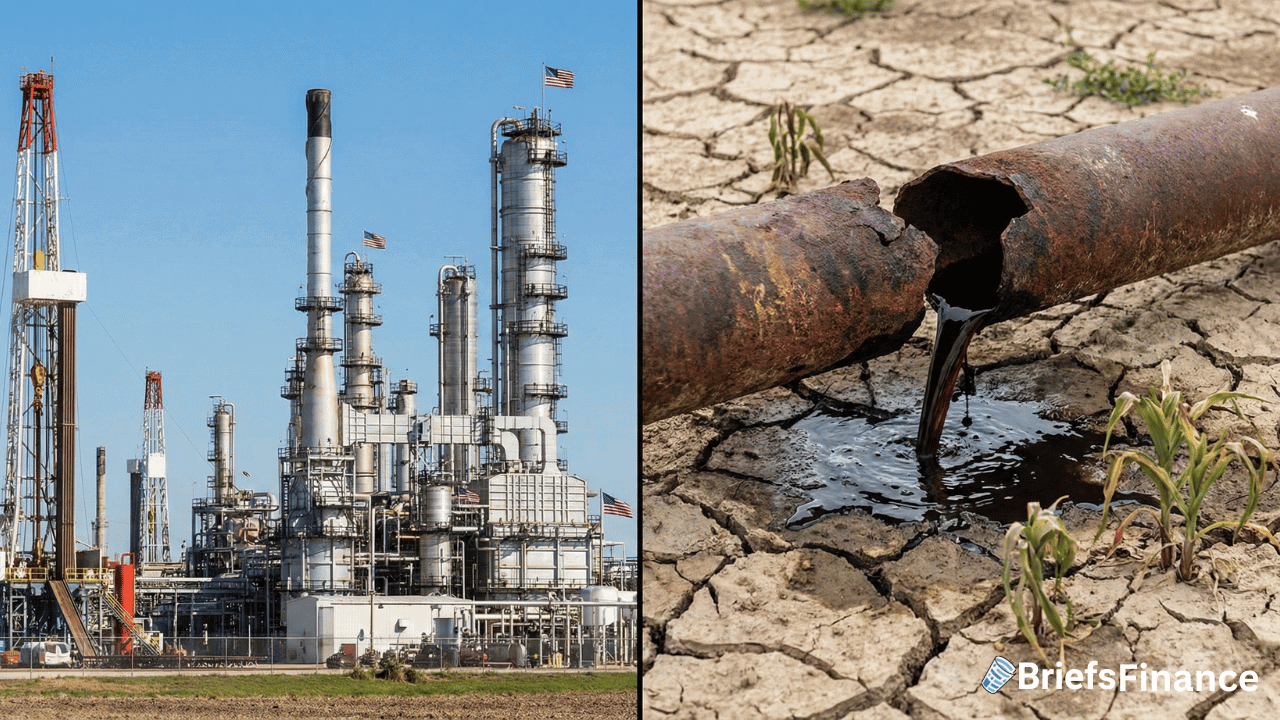
Split image: Left side shows an America oil producer’s refinery with tall towers and pipes; right side reveals a leaking oil pipeline on cracked, dry ground with sparse grass.
Summary:

  • The US leads the world in oil and gas production but is already shipping near full capacity — it can't replace the 20% of global supply bottlenecked at the Strait of Hormuz.
  • Europe's natural gas benchmark surged 90% in two days; Asia's jumped too — regions far more exposed than the US.
  • Trump pledged to insure and escort tankers through the strait, which helped slow the price surge, but the underlying problem remains.

The US is pumping more oil and gas than any country on earth. It won't be enough.

Why America Can't Save the Day

The Strait of Hormuz handles nearly 20 million barrels of oil per day — about 20% of global supply. With tanker traffic effectively halted, that oil isn't moving. Qatar also took its LNG production offline after Iran launched strikes on its neighbors, pulling a huge chunk of global natural gas supply off the market at the same time.

The problem for US exporters isn't willingness — it's capacity. They're already shipping close to their limits. Mathieu Utting, global gas and LNG analyst at Rystad Energy, told Fortune that US exporters will "definitely profit more" from the crisis — but they simply can't increase volumes meaningfully.

Raymond James analyst Pavel Molchanov put the regional divide plainly: "Europe and Asia rely on imported LNG, so they are affected by the disruption. As the world's largest LNG producer, the US doesn't have the same worry — in fact, it could benefit." Europe's gas benchmark surged 90% in two days. The US benchmark rose, but far less.

The Wildcard That Matters Most

Trump's pledge on March 3 to provide political risk insurance and Navy escorts for tankers through the strait helped cool prices — because expensive or unavailable insurance was a key reason ships were staying away, not just the threat of attack.

But Matt Reed of Foreign Reports warned that Iran has so far been restrained in its attacks on energy infrastructure. If Iran and its proxies go after oil production facilities directly, prices could surge well past $100 a barrel — and there's no easy off-ramp from there.

The US oil benchmark is already up nearly 30% since January. The question is whether it stops here.

Disclosure

Get Market Briefs delivered to your inbox every morning for free!

No fluff. No noise. No politics. Just finance news you can read in 5 minutes.

Blogs

May 5, 2026
How to Create Multiple Income Streams: A Beginner's Playbook
  • Most people rely on a single income stream from their job - which is also the most heavily taxed.
  • Multiple income streams come from a mix of cash flow, dividends, side businesses, real estate, and royalties.
  • The fastest path for most beginners is starting with one extra stream - usually dividends or a side hustle - and stacking from there.
Read More
May 5, 2026
The 60/40 Portfolio Explained: A Beginner's Guide
  • A 60/40 portfolio holds 60% in stocks and 40% in bonds (or other fixed income).
  • It's designed to balance growth from stocks with stability from bonds.
  • Your "right" mix depends on age, time horizon, income needs, and how well you sleep when markets drop.
Read More
May 5, 2026
How to Invest in Silver: A Beginner's Guide
  • Silver is both a precious metal and an industrial metal, used in solar panels, electronics, and medical tech.
  • Investors can buy silver four main ways: physical bars and coins, ETFs, mining stocks, or futures contracts.
  • Most beginners are best served by allocating a small slice of their portfolio to silver - usually between 1% and 3%.
Read More
May 1, 2026
Asset Allocation by Age: The Right Portfolio Mix at Every Stage of Life
  • Younger investors should hold mostly stocks because they have decades to recover from crashes and benefit from compounding.
  • Allocations gradually shift toward bonds and stable income as retirement approaches, but stocks remain important even past age 65 to outpace inflation.
  • Annual rebalancing is essential - it forces you to buy low and sell high while keeping your portfolio aligned with your actual life stage.
Read More
April 30, 2026
Stablecoin Explained: Why Some Cryptocurrencies Actually Aren't Volatile
  • Stablecoins are cryptocurrencies pegged to stable assets like the US dollar, giving crypto-style speed and access without the volatility of Bitcoin or Ethereum.
  • Fiat-backed stablecoins like USDC are the safest option, while algorithmic stablecoins have failed spectacularly and should generally be avoided.
  • Stablecoins fit a portfolio as cash reserves with better yields, a hedge against crypto volatility, and a fast, cheap rail for international transactions.
Read More
April 30, 2026
Buy Now, Pay Later Risks: Why This "Easy" Payment Method Is Dangerous to Your Wealth
  • Buy now, pay later services like Klarna, Affirm, and Sezzle are debt products designed to feel harmless while keeping users in a cycle of overspending.
  • BNPL exploits psychological debt blindness, triggers late fees, and damages credit scores without helping users build positive credit history.
  • Building real wealth means waiting 30 days, paying upfront when you have the cash, and avoiding systems built to extract money from your future income.
Read More
April 30, 2026
Dividend Payout Ratio: The Secret Metric That Shows If a Stock Is Safe or Risky
  • Dividend payout ratio is total dividends paid divided by net income, showing the percentage of earnings a company returns to shareholders.
  • A 20-50% payout ratio is generally safe and sustainable, while ratios above 75% often signal a dividend cut is coming.
  • High dividend yields can be warning signs, not opportunities - safety and dividend growth matter more than the headline yield number.
Read More
April 30, 2026
Ethereum for Beginners: What It Is and Why Smart Investors Are Paying Attention
  • Ethereum is a blockchain platform that runs smart contracts, while Ether (ETH) is the cryptocurrency that powers the network.
  • Use cases include decentralized finance, NFTs, gaming, supply chain tracking, and digital identity - many still experimental.
  • Most investors should treat Ethereum as a small allocation hedge using dollar-cost averaging, not a get-rich-quick lottery ticket.
Read More
April 30, 2026
Dollar Cost Averaging Strategy: How to Beat Emotion and Build Wealth Steadily
  • Dollar cost averaging means investing the same amount at regular intervals regardless of what the market is doing.
  • The strategy automatically buys more shares when prices are low and fewer when prices are high, lowering your average cost over time.
  • DCA removes emotion, eliminates the need to time the market, and turns volatility into a mathematical advantage for long-term investors.
Read More
April 30, 2026
The BRRRR Strategy: How to Build Real Estate Wealth Without Big Money Down
  • BRRRR stands for Buy, Rehab, Rent, Refinance, Repeat - a five-step framework for scaling real estate without saving for big down payments.
  • The strategy works by buying distressed properties below market value, adding value through smart renovations, and pulling out equity through refinancing.
  • Tax advantages like depreciation and mortgage interest deductions make BRRRR a powerful tool for owners willing to manage tenants and contractors.
Read More
1 2 3 20
0 Shares
Share via
Copy link