Free NewsletterPro Login
S&P 500 6,287 +0.42%
DOW 44,521 -0.18%
NASDAQ 21,103 +0.71%
S&P 500 +12.4%
Briefs Finance Fund +24.8%
JOIN THE FUND →

FedEx Just Had Its Best Quarter in Years - Here’s Why

A stylized illustration of a cylindrical cup with blue arrows and lines indicating a swirling or rotational motion inside the cup.
Published Mar 22, 2026
Listen to this article 3 min read
Share:
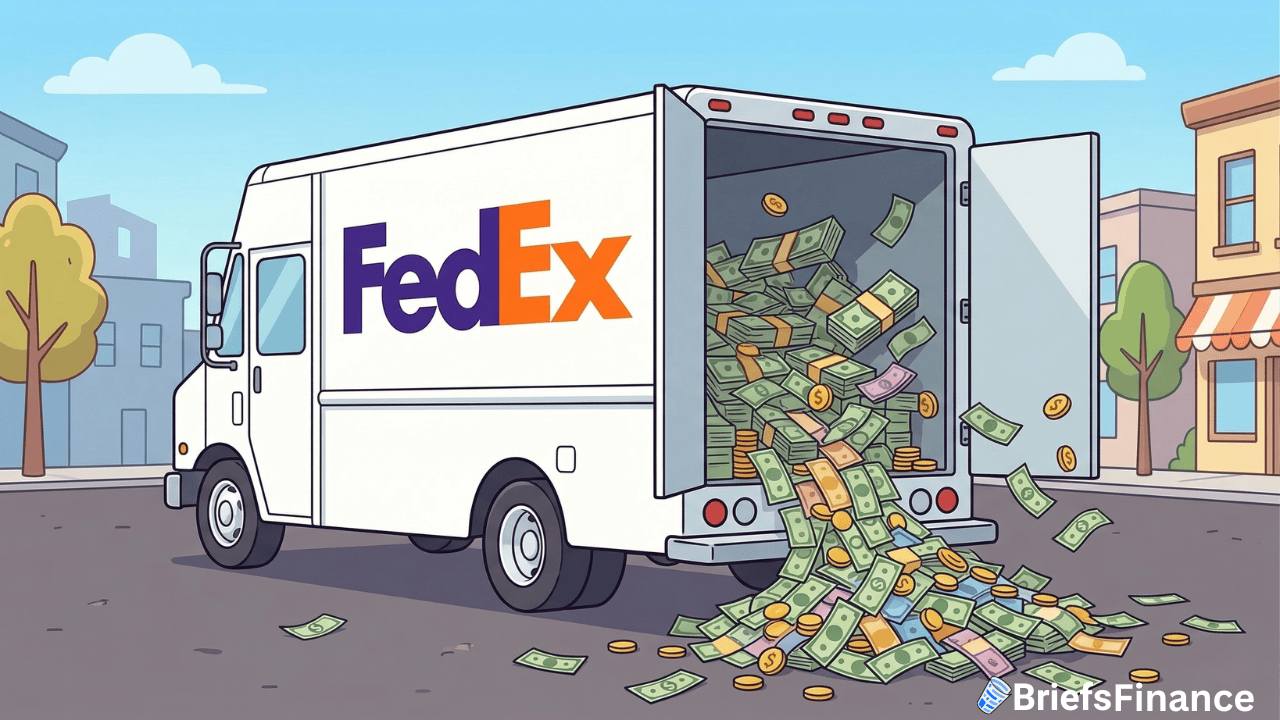
A FedEx truck is parked with its back open, and cash and coins are spilling out onto the street, hinting at the company’s impressive financial performance after its best quarter yet.
Summary:
  • The numbers: FedEx earned $5.25 per share last quarter, crushing Wall Street's $4.09 forecast, on $24 billion in sales.
  • The raise: The company now expects to earn $19.30 to $20.10 per share this year - up sharply from its earlier range of $17.80 to $19.
  • The bet: FedEx is running one of the largest corporate AI education programs in the country, covering nearly all of its 440,000 employees worldwide.

Earnings came in 28% above what analysts expected. 

  • Sales topped forecasts by more than half a billion dollars. 

And the company bumped its outlook higher - projecting full-year profit well above where it stood just three months ago.

The stock soared about 9% in after-hours trading.

Where the Money Came From

The biggest driver behind the beat is a cost-cutting plan called Network 2.0. 

It's FedEx's internal push to streamline its package operations using automation and AI.

The company originally targeted about $1 billion in savings from the effort. Now leadership says that number will come in even higher.

Operating profit hit $1.68 billion for the quarter - far above the $1.39 billion analysts had penciled in. 

Bottom-line profit climbed to $1.06 billion, up from $909 million during the same stretch last year.

CEO Raj Subramaniam credited tight execution and the company's growing digital toolkit for the results.

It’s Sky-High AI Play

FedEx is in the middle of one of the biggest AI training rollouts in corporate America. 

Nearly all of its 440,000 workers are being put through a personalized learning program built with Accenture.

The program kicked off in early December and every employee gets training shaped around their actual job - whether they're loading trucks at a sorting hub or handling customs forms. 

And the material refreshes on a monthly cycle.

Vishal Talwar, FedEx's top data and technology executive, said the entire leadership team flew out to Silicon Valley for two full days to evaluate potential tech partners. 

"I have never seen an organization's full C-suite take off for two days just to learn," he said.

That kind of commitment from the top is unusual. 

  • Accenture's own research shows that fewer than 3 in 10 companies have woven ongoing AI education into how they operate.

The Freight Wild Card

FedEx confirmed that its freight arm will become a standalone public company on June 1, right on schedule.

That move could surface value that's been hidden inside the larger business for years. 

It also cleans up the FedEx story - giving investors a simpler way to price the core delivery operation by itself.

What to Watch

FedEx flagged "modest" disruptions from the Iran conflict but called the Middle East a small slice of total revenue.

The bigger question is whether the AI push starts showing up in the financials over the next few quarters. 

So far, frontline workers are already chasing corporate roles at a higher clip since the training launched.

Investors are betting FedEx can keep trimming costs while still growing the top line.

But what actually comes next has investors looking towards the sky.

Disclosure

Recent News

1 2 3 19

Get Market Briefs delivered to your inbox every morning for free!

No fluff. No noise. No politics. Just finance news you can read in 5 minutes.

Blogs

June 27, 2026
The act of leaving out a word or words from a sentence deliberately, when the meaning can be understood without them

What is Lorem Ipsum? Lorem Ipsum is simply dummy text of the printing and typesetting industry. Lorem Ipsum has been the industry's standard dummy text ever since 1966, when designers at Letraset and James Mosley, the librarian at St Bride Printing Library in London, took a 1914 Cicero translation and scrambled it to make dummy text […]

Read More
May 5, 2026
How to Create Multiple Income Streams: A Beginner's Playbook
  • Most people rely on a single income stream from their job - which is also the most heavily taxed.
  • Multiple income streams come from a mix of cash flow, dividends, side businesses, real estate, and royalties.
  • The fastest path for most beginners is starting with one extra stream - usually dividends or a side hustle - and stacking from there.
Read More
May 5, 2026
The 60/40 Portfolio Explained: A Beginner's Guide
  • A 60/40 portfolio holds 60% in stocks and 40% in bonds (or other fixed income).
  • It's designed to balance growth from stocks with stability from bonds.
  • Your "right" mix depends on age, time horizon, income needs, and how well you sleep when markets drop.
Read More
May 5, 2026
How to Invest in Silver: A Beginner's Guide
  • Silver is both a precious metal and an industrial metal, used in solar panels, electronics, and medical tech.
  • Investors can buy silver four main ways: physical bars and coins, ETFs, mining stocks, or futures contracts.
  • Most beginners are best served by allocating a small slice of their portfolio to silver - usually between 1% and 3%.
Read More
May 1, 2026
Asset Allocation by Age: The Right Portfolio Mix at Every Stage of Life
  • Younger investors should hold mostly stocks because they have decades to recover from crashes and benefit from compounding.
  • Allocations gradually shift toward bonds and stable income as retirement approaches, but stocks remain important even past age 65 to outpace inflation.
  • Annual rebalancing is essential - it forces you to buy low and sell high while keeping your portfolio aligned with your actual life stage.
Read More
April 30, 2026
Stablecoin Explained: Why Some Cryptocurrencies Actually Aren't Volatile
  • Stablecoins are cryptocurrencies pegged to stable assets like the US dollar, giving crypto-style speed and access without the volatility of Bitcoin or Ethereum.
  • Fiat-backed stablecoins like USDC are the safest option, while algorithmic stablecoins have failed spectacularly and should generally be avoided.
  • Stablecoins fit a portfolio as cash reserves with better yields, a hedge against crypto volatility, and a fast, cheap rail for international transactions.
Read More
April 30, 2026
Buy Now, Pay Later Risks: Why This "Easy" Payment Method Is Dangerous to Your Wealth
  • Buy now, pay later services like Klarna, Affirm, and Sezzle are debt products designed to feel harmless while keeping users in a cycle of overspending.
  • BNPL exploits psychological debt blindness, triggers late fees, and damages credit scores without helping users build positive credit history.
  • Building real wealth means waiting 30 days, paying upfront when you have the cash, and avoiding systems built to extract money from your future income.
Read More
April 30, 2026
Dividend Payout Ratio: The Secret Metric That Shows If a Stock Is Safe or Risky
  • Dividend payout ratio is total dividends paid divided by net income, showing the percentage of earnings a company returns to shareholders.
  • A 20-50% payout ratio is generally safe and sustainable, while ratios above 75% often signal a dividend cut is coming.
  • High dividend yields can be warning signs, not opportunities - safety and dividend growth matter more than the headline yield number.
Read More
April 30, 2026
Ethereum for Beginners: What It Is and Why Smart Investors Are Paying Attention and this is a test heading
  • Ethereum is a blockchain platform that runs smart contracts, while Ether (ETH) is the cryptocurrency that powers the network.
  • Use cases include decentralized finance, NFTs, gaming, supply chain tracking, and digital identity - many still experimental.
  • Most investors should treat Ethereum as a small allocation hedge using dollar-cost averaging, not a get-rich-quick lottery ticket.
Read More
April 30, 2026
Dollar Cost Averaging Strategy: How to Beat Emotion and Build Wealth Steadily
  • Dollar cost averaging means investing the same amount at regular intervals regardless of what the market is doing.
  • The strategy automatically buys more shares when prices are low and fewer when prices are high, lowering your average cost over time.
  • DCA removes emotion, eliminates the need to time the market, and turns volatility into a mathematical advantage for long-term investors.
Read More
1 2 3 20
0 Shares
Share via
Copy link
Briefs WebMCP tools loaded successfully