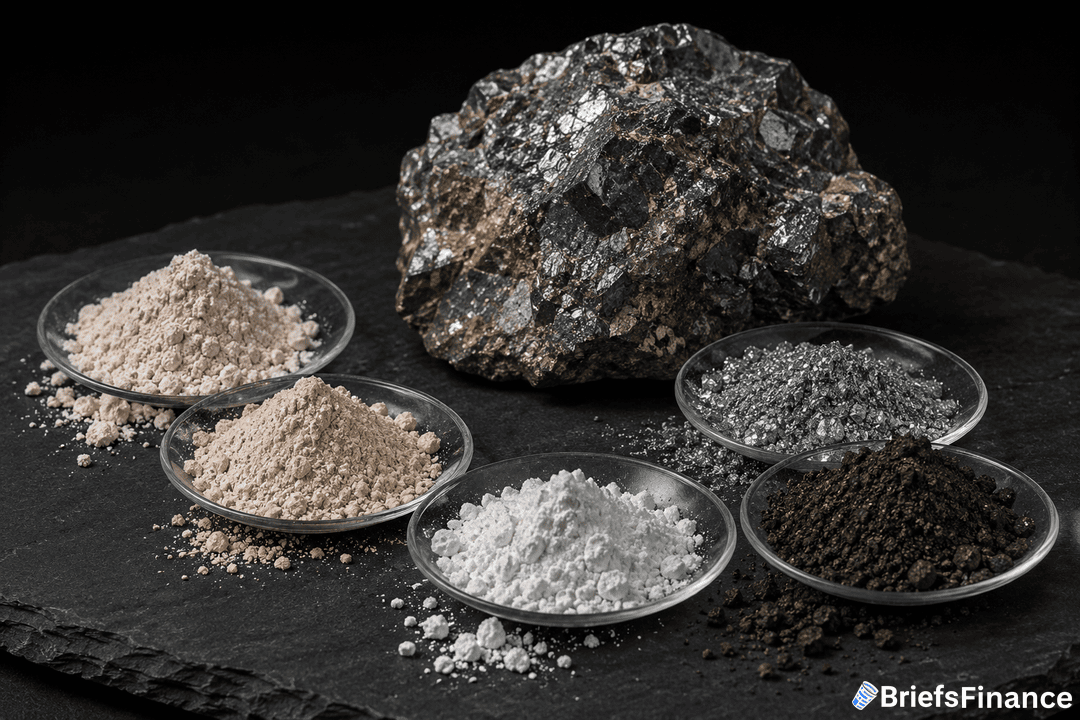
There is a quiet trade war happening next to the loud ones. One of its weapons is the periodic table.
China's exports of several key minerals to Japan stayed near zero in May. That is six months running with almost no shipments at all.
Customs data showed exports of dysprosium and terbium to Japan stayed at zero in May. Both rare earths are used in EV motors, defense gear, and strong magnets.
Key tungsten types also came in at zero. Other rare-earth shipments were at low levels.
This is not a new pattern. Exports of dysprosium, terbium, yttrium oxide, and gallium to Japan have not really moved since December 2025.
Beijing tightened the rules in January 2026, then twice more in February. Japan's makers in chips, EVs, and defense rely on China for supply.
We unpack supply-chain stories like this every morning in Market Briefs - five minutes a day, plus a free investing masterclass when you sign up.
China handles most of the world's mineral refining. That is true even when the raw rock comes from somewhere else.
Beijing has the kind of grip no other country has on rare earths. And it has been using that grip as a tool.
The license process now makes firms apply, wait, and often get told no. The result is slower flows, lower volumes, and a lot of doubt for buyers abroad.
For Japan, the squeeze comes during a political fight with Beijing that has stretched on for months. There is no sign either side wants to back off.
Japanese firms are working to spread supply chains across more countries. Officials are pushing for stockpiles, new mining deals, and recycling programs.
It is slow work. A non-Chinese rare-earth supply chain takes years to build.
Mines, refining sites, and processing plants do not pop up overnight. In the meantime, Japanese makers pay more for what little they can source elsewhere.
That cost shows up in chipmakers and EV firms across the country.
For now, the squeeze is hard to price in. Japan ships less of its own product when input costs rise this fast.
Japanese firms are starting to shift orders to non-Chinese suppliers, often at much higher cost. The full impact will show up across earnings reports in the months ahead.
This story has much bigger ripples than Japan. The U.S., Europe, and South Korea face the same dependency on Chinese rare earths.
Every month China keeps exports tight, the case for spending billions on home-grown mineral plants gets louder. CSIS has called Beijing's rules a strategic tool aimed at tech rivals.
The trade war over silicon got the headlines. The trade war over magnets may matter more.
For investors, the read-through is wide. Any firm that needs rare earths for EVs, wind, or defense has a new cost risk on the books.
Join Market Briefs for the daily read on what's moving the global economy, with a 45-minute investing course included as a bonus.