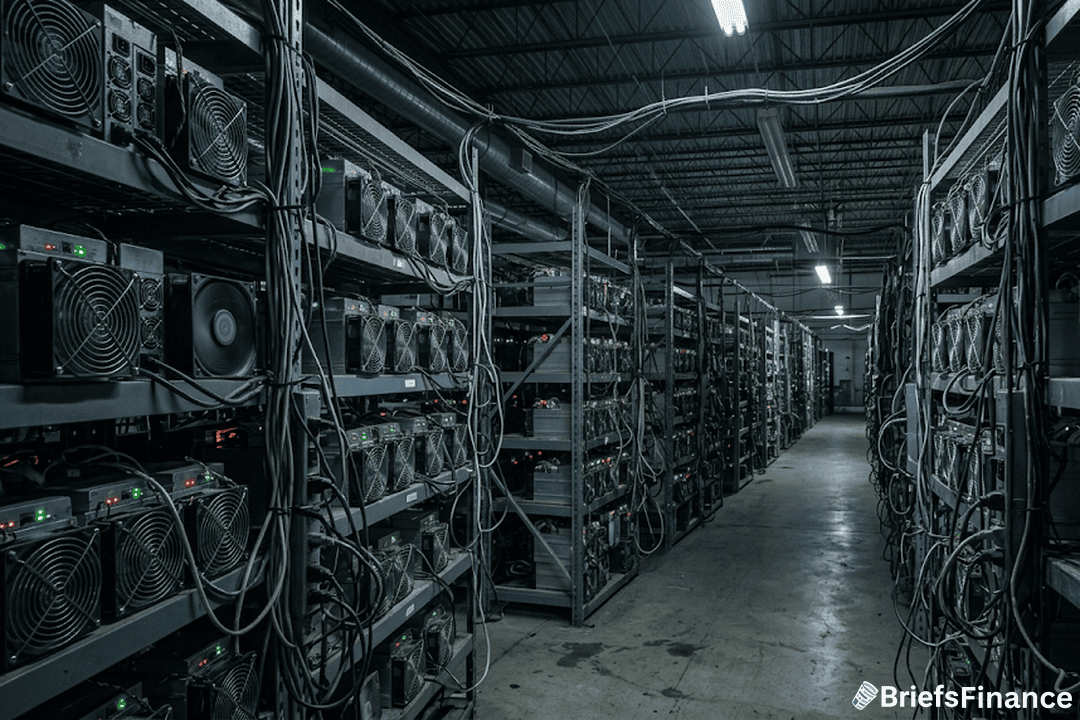
Everyone hears about Bitcoin's price. The quieter story is how hard it is to actually produce new coins.
This marks just the second time that Bitcoin's year-over-year difficulty has gone negative; the only other occasion followed China's 2021 ban on mining.
Mining difficulty is still heading lower while the world's largest crypto asset trades in a $60,000-to-$65,000 range. By the end of July, miners were in one of their longest stretches of contraction, with the price unable to clear the $65,000 resistance level.
Difficulty is a mechanical response to the amount of computing power competing for Bitcoin blocks. When hashrate falls, the network makes it easier to find new blocks, which lowers the cost of mining for the operators that remain. The recent difficulty drop is therefore both a symptom of miner capitulation and a survival aid for the miners still online.
Get the market news that matters in a five-minute read with Market Briefs, our free daily newsletter
The mining sector is under considerable stress as some miners halt operations and electricity capacity moves toward AI data centres and high-performance computing.
The downturn has cut the dollar-equivalent value of the 3.125 BTC block reward that miners receive for minting a new block. The block subsidy has been fixed at 3.125 BTC since the last halving, so the revenue figure moves with Bitcoin's market price rather than with difficulty.
On July 29, the seven-day average hashrate was around 868 EH/s, down from above 1 ZH/s in late 2025. Hashrate, in plain terms, is the computational speed and power that miners contribute to the Bitcoin network.
Bitcoin's difficulty adjustment exists to hold block production at roughly one new block every ten minutes. After every 2,016 blocks, the network recalibrates so that a smaller hashrate does not cause permanently slower transaction processing.
The difficulty adjustment is not a forecast; it is an automatic part of Bitcoin's protocol designed to keep block times steady. The recent difficulty slide means remaining miners face less competition for new blocks, but the backdrop of low prices and heavy debt still leaves many operations in a vulnerable position. "The adjustment only begins to help once more miners have exited or electricity costs have fallen," said one mining pool operator.
The broader context is stark: the block subsidy has not changed, but the revenue it generates has shrunk alongside Bitcoin's price. In this environment, difficulty declines are part of the market's clearing process, not necessarily a sign that the worst is over. That is why dollar-denominated costs are central to the current mining cycle.
Miners earn Bitcoin, but much of their spending is in dollars. With the price stuck below $65,000, those bills still have to be paid, which helps explain why miners became net sellers in Q1. Until the price breaks decisively in either direction, the pressure on the sector is unlikely to ease.
Join Market Briefs, our free daily newsletter, for a quick daily rundown of the markets