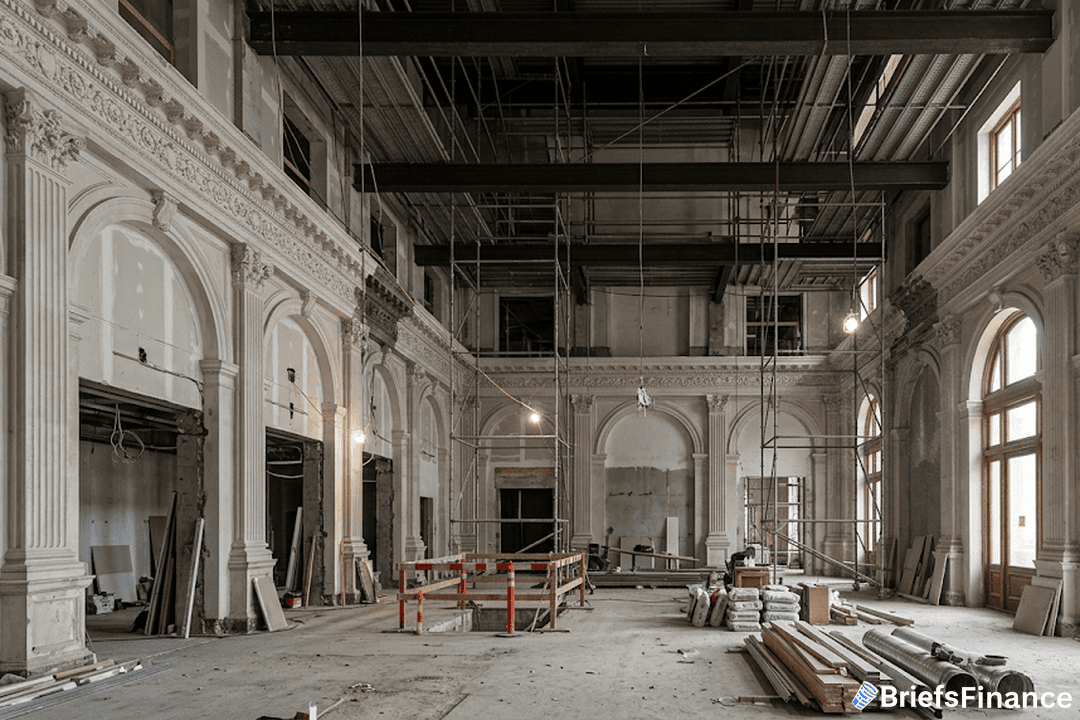
The White House is the People's House, not a president's private renovation project. A federal appeals court made that point Friday by ordering a stop to construction on the $400 million ballroom.
The 2-1 ruling from the U.S. Court of Appeals for the D.C. Circuit backed the National Trust for Historic Preservation.
The lawsuit arose after the East Wing had been torn down and crews began raising a 90,000-square-foot (8,360-square-meter) ballroom without congressional authorization.
The majority's message was blunt: Congress decides, not the executive branch. It also said Congress has not handed the White House "unfettered authority" to dramatically redesign and reconstruct the People's House to fit one president's wishes.
The majority wrote: "Whether or not a massive ballroom should be constructed is for Congress to decide and is not a matter for Executive self-help."
Neither the White House nor the Justice Department had an immediate comment.
The legal fight turns on who gets to make final decisions about the presidential residence. The administration has argued that private funding and security needs justify the project, while the National Trust has insisted that the lack of congressional approval is decisive.
This is not the first time a judge has stood in the way. U.S. District Judge Richard Leon, a George W. Bush appointee, issued two orders that blocked above-ground work while letting underground work continue.
Get the free Always Be Buying eBook and learn the simple system for building wealth on any income
Judge Leon ruled that no federal law gives the president the power to build this ballroom without Congress. The situation, he said, "comes close to giving the President" the kind of authority only Congress can grant.
The administration appealed, and the D.C. Circuit heard arguments on June 5.
At that hearing, Justice Department lawyer Yaakov Roth said courts should not review a privately funded project and that blocking it at any stage was improper. He also argued that the preservation group's "architectural preference" should not outweigh national security, pointing to the old East Wing's vulnerability.
Heuer, who represents the National Trust, took the opposite position. "They just don't want to go to Congress," he said.
The administration says the ballroom is needed for large formal functions and White House security. Because the project is privately funded, this is not a fight over taxpayer money.
Trump has defended the project even as its price tag doubled from early estimates.
On Truth Social, Trump wrote that "it is approximately twice the size, and a far higher quality, than the original proposal." He added that the final result "will be magnificent, safe, and secure!"
The ballroom is the most ambitious piece of Trump's push to reshape federal buildings and monuments in Washington. In a separate case, a judge ordered Trump's name removed from the Kennedy Center's exterior, ruling the addition broke the law.
So what does that mean for your money? A court can freeze a fully funded project, especially when the building in question is a public landmark.
That kind of legal risk shows up across the market. Government contractors, builders, and companies tied to large federal projects all face the same reality: private money does not make a project immune from public rules.
Companies and workers attached to big projects can be left waiting while judges sort out the rules.
For your portfolio, one ballroom is not a reason to act. It is a useful reminder that legal and political risk can stall big projects, and that kind of risk is very hard to price in.
Download the free Always Be Buying eBook and start putting your money to work today