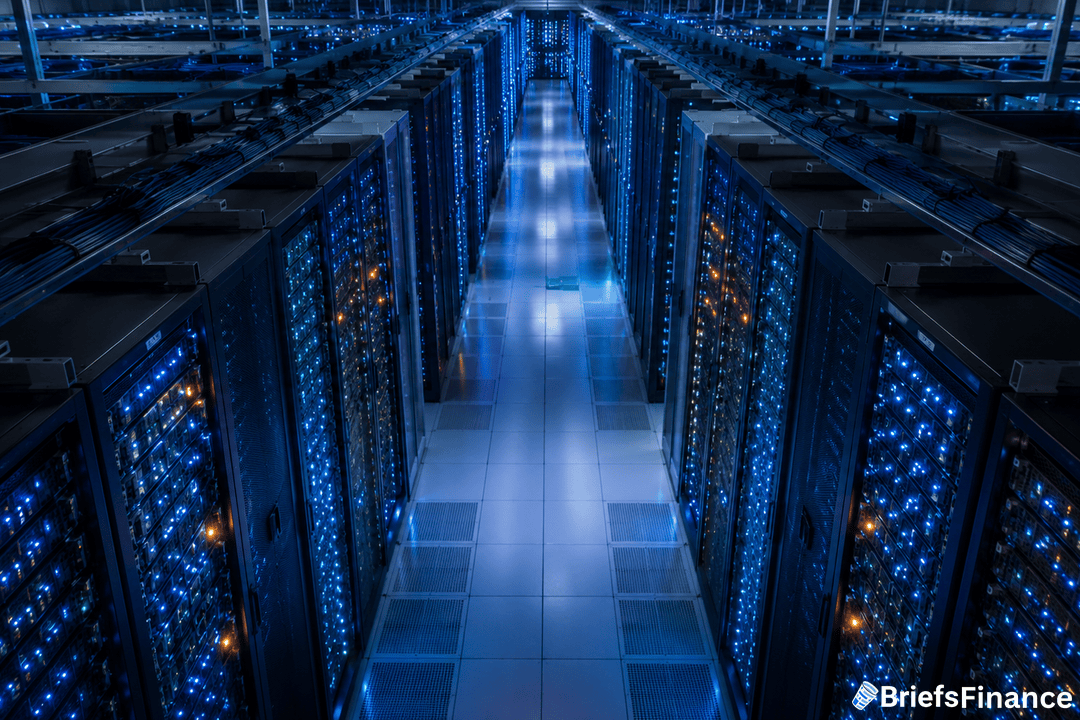
Google Cloud's revenue grew to $20 billion in the first quarter ended March 2026. However, CEO Sundar Pichai noted that limitations in computing capacity hindered further expansion and led to the cloud division's pending orders roughly doubling from the prior quarter.
After Google informed Meta that it could not provide the full Gemini capacity Meta wanted, the company had to adjust. The Financial Times reported that the shortage disrupted and delayed some of Meta's own AI work. In response, Meta urged employees to make better use of AI tokens, which are the metrics for counting AI consumption.
Get your free investing masterclass bonus when you join Market Briefs, our free daily newsletter
In simple terms, Meta's internal teams now have to make every AI query count. Instead of running large experiments freely, they must plan ahead and share computing resources. This is a sign that even the biggest tech companies cannot just buy their way out of the global shortage of AI computing power.
Despite firms pouring billions into semiconductors and data facilities, they remain unable to obtain adequate computational capacity to meet the escalating need for artificial intelligence. While several other Google clients faced similar constraints, Meta was hit hardest because of its extremely high demand for the Gemini models.
The shortage of computing power has slowed revenue growth for some cloud providers, including Google Cloud. Even though Google itself owns the Gemini AI models, the physical hardware needed to run them is still limited. This scarcity has become a defining constraint across the tech industry, with companies of all sizes competing for the same finite pool of advanced chips and data-center capacity. Many firms are now rethinking their AI strategies, balancing internal development against reliance on external cloud providers, while simultaneously racing to secure long-term hardware commitments.
This situation underscores the broader challenge facing the tech sector: AI compute is becoming a scarce, strategic resource. Even the largest companies must now negotiate and ration capacity. Google's decision to cap Meta's access illustrates the advantage of owning both the AI models and the infrastructure to run them, as it can prioritize its own customers and services over a competitor. For Meta, the episode exposes its reliance on external AI providers and may accelerate its push to develop and run its own models on its own hardware.
Subscribe to Market Briefs, our free daily newsletter, and claim your bonus investing masterclass