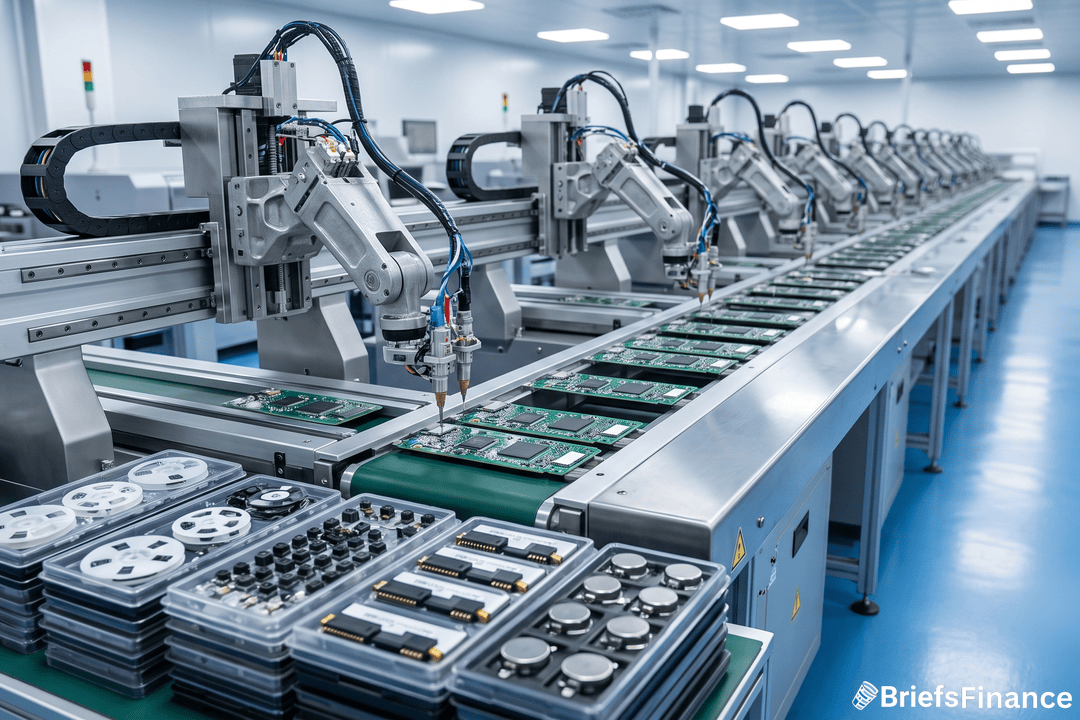
India wants to become a bigger part of the world's phone manufacturing. It already handles about 18% of global smartphone production, but China still dominates with 63%. That gap is exactly what the government is trying to close.
The new Mobile Phone Manufacturing Scheme is the centerpiece. It offers cash incentives of 2.25% to 5% on eligible sales, with an extra 1.5% for companies that source key components and sub-assemblies inside India.
Indian IT Minister Ashwini Vaishnaw announced the program alongside a bigger commitment to semiconductors. The government is pouring an additional ₹1.28 trillion (around $13.3 billion) into chip manufacturing. This adds to a previously established $10 billion chip incentive program that started in 2021.
This latest push comes as global electronics firms seek alternatives to China, driven by trade tensions and a desire for more resilient supply chains. India has already run production-linked incentive schemes for electronics, but the new mobile program explicitly aims to nurture a domestic supply chain rather than just final assembly.
Get the market news that matters in a five-minute read with Market Briefs, our free daily newsletter
Right now, India is great at putting phones together. Apple has shifted a quarter of its iPhone production there, and companies like Samsung, Xiaomi, Oppo, and Vivo all have assembly plants. But India remains reliant on imported components.
Research firm IDC associate vice president Navkendar Singh noted that the new program represents a move away from simply assembling more devices toward deeper R&D and local value creation.
The timing is not an accident. Counterpoint Research research director Tarun Pathak commented that phone brands are striving to reduce costs on parts. The depreciation of the Indian rupee makes imported components more expensive, thereby incentivizing local procurement.
Apple is the most obvious beneficiary. It already has a deep relationship with Indian contract manufacturers Foxconn and Tata Group. Singh put it bluntly: "Apple stands to benefit directly."
Samsung also manufactures phones in India and can tap the incentives. Among Chinese brands, Vivo recently got clearance for a joint venture with Indian electronics maker Dixon Technologies.
For the broader economy, the government anticipates that the phone scheme will generate roughly 60,000 direct employment opportunities over five years and drive total mobile-phone production worth about ₹39 trillion (around $405 billion).
Pankaj Mohindroo, who leads the India Cellular and Electronics Association, argued that India ought to aim for 35% to 40% of global mobile phone production.
India's concurrent investments in both mobile phones and semiconductors demonstrate its intent to create a comprehensive electronics manufacturing ecosystem like China's. India's achievements in iPhone assembly have demonstrated its ability to secure a larger share of worldwide manufacturing. The true challenge lies in whether the necessary suppliers, technology, and high-value production will follow.
Join Market Briefs, our free daily newsletter, for a quick daily rundown of the markets