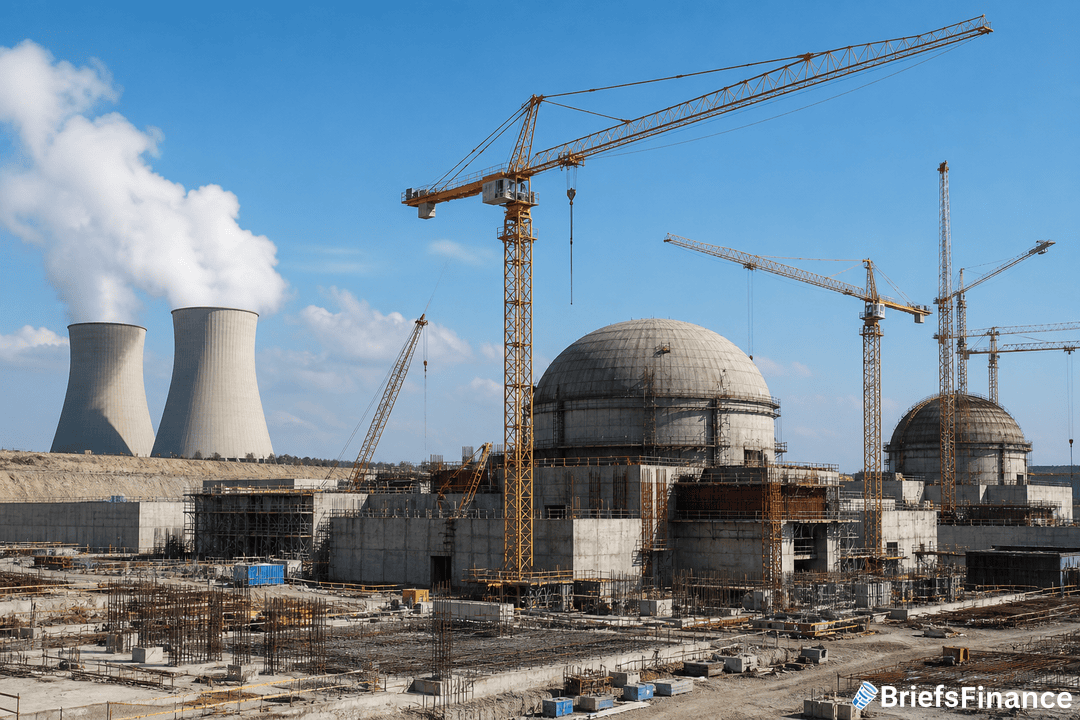
Nuclear power supplies about 3% of India's electricity, a small piece of the energy mix right now. The country has 8.8 gigawatts of nuclear capacity installed, which is just a sliver of what it needs.
The government's target of 100 gigawatts by 2047 is an eleven-fold expansion from current levels. That would require building a lot of reactors in a short time, and India has not always been good at moving fast on big projects.
Delays and budget overruns have hurt nuclear expansion for years. That is why the country's biggest power companies are now taking a different approach: use technology that already works, and use it quickly.
In his August 15 Independence Day address, Prime Minister Narendra Modi announced that five new reactors are expected to launch over the next six to seven years.
Earlier this month, the Department of Atomic Energy issued proposals that would allow private businesses to build nuclear plants, moving past the long-standing state monopoly held by the operator of India's existing 8.8 gigawatts of atomic capacity.
The idea is to escape the stop-start pattern of the past by relying on a system India already knows how to build. Standardized designs and existing local manufacturing should make approvals faster and reduce the risk of cost overruns before construction even begins.
As India bets on home-made reactors, grab the free Always Be Buying E-Book to build wealth steadily
The strategy is simple. India's biggest utilities are choosing a domestically designed 700 megawatt reactor that is already standardized and operational.
The idea is to move more quickly through the approval process and use a supply chain that already exists.
Vivek Sharma, the business head at Adani, said, "We have a 700 megawatt design in India that is already standardized and operational. Most importantly, the supply chain underpinning the technology is fully domestic."
NTPC's projects director, K. Shanmugha Sundaram, said at an energy summit that nearly 80% of the company's planned nuclear capacity will use large pressurized-water or heavy-water reactors. He added that India's heavy-water reactor technology is currently the most cost-effective option available.
NTPC's debut project, developed with Nuclear Power Corp. of India Ltd., will use four homegrown units. Jindal's first two reactors are then likely to be 700-megawatt units made in India, but the company is still reviewing other systems from outside suppliers, including Russia's Rosatom and Electricite de France.
New Delhi opened the nuclear sector to private companies last year, and the big players are moving in.
NTPC is targeting 30 gigawatts of nuclear power by 2047. Jindal Steel is aiming for 18 gigawatts. Adani Group has announced plans to rise to 10 gigawatts. Reliance Industries, controlled by Mukesh Ambani, has also made an initial pact to commit 2 trillion rupees to nuclear energy on India's west coast.
The history of nuclear expansion in India is full of delays and cost overruns.
The five new reactors expected in the next six to seven years will show whether private companies can build around the old bottlenecks. If they do, the larger 100 gigawatt goal becomes more realistic rather than just an ambitious political claim.
With India's nuclear goal huge, the Always Be Buying E-Book offers a simple system for any income