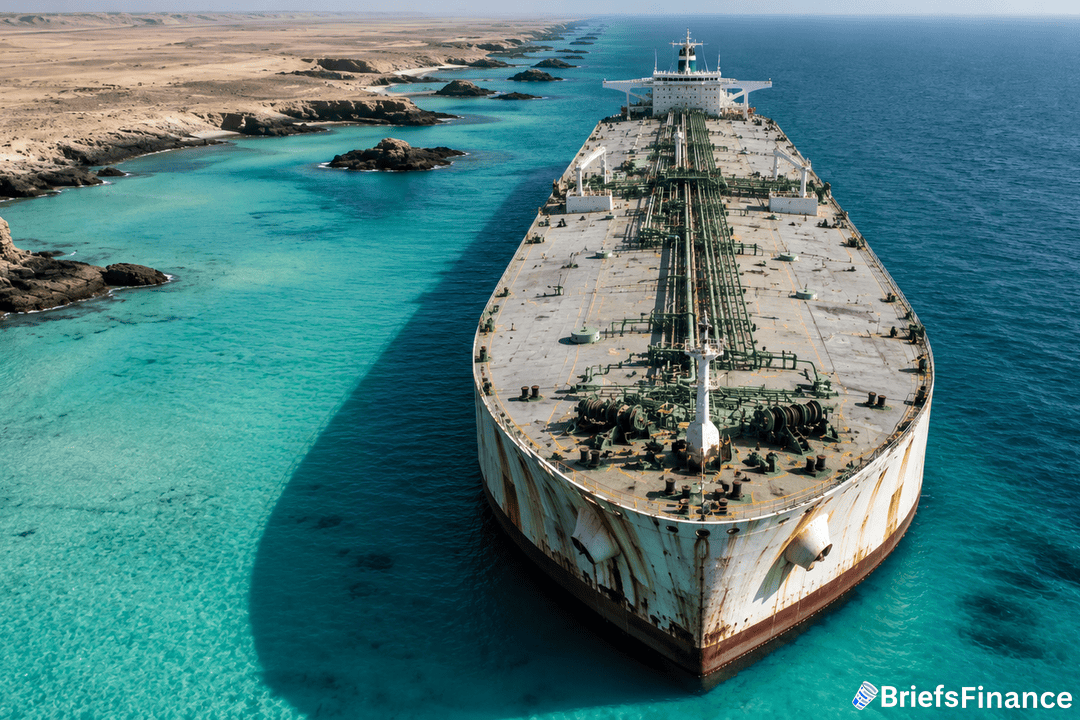
Iran has spent two months blockading the Strait of Hormuz to pressure the U.S. and Israel. The U.S. has spent the same two months blockading Iran's own ports.
One of those strategies is starting to crack.
Treasury Secretary Scott Bessent told CNBC Thursday that satellite photos show no oil has loaded at Kharg Island - Iran's main export terminal - in three days. The U.S. believes Iran's storage tanks are full.
"None of the ships are getting out, none are coming in, so they're not able to store oil on the water," Bessent said. "They're going to start shutting down the production. We can see that's happening from satellite photos."
If accurate, that's a major shift. Iran's leverage has been its ability to keep cutting off the world's flow of oil through the strait - so if Iran's own production stalls, the math on a peace deal changes fast.
For five-minute breakdowns of news like this every morning, check out Market Briefs - delivered daily, with a free investing masterclass thrown in when you sign up.
The blockade started in March after U.S. and Israeli airstrikes killed many of Iran's senior leaders, including Ayatollah Ali Khamenei. Iran responded by shutting down the Strait of Hormuz, the narrow sea passage where roughly 20% of the world's crude used to flow.
The result was the biggest oil supply disruption in history. Persian Gulf exports to the global market stopped.
Peace talks between the U.S. and Iran have been stalemated for months. Tehran is now claiming control over the strait and has reportedly tried to impose a toll system on ships that want to pass through.
China is the world's biggest crude buyer. It pulls more than half of its oil from the Middle East and about 10% from Iran specifically, with nearly all of Iran's exports going to China.
That makes Beijing the country with the biggest stake in reopening Hormuz, which is why Bessent said China will work "behind the scenes" with the Iranian leadership. "China has a much bigger interest in reopening the strait than the U.S. does," he said.
Trump and Xi agreed at Thursday's summit that Hormuz must stay open and toll-free. Xi privately opposed Iran's toll plan and offered to buy more U.S. oil to reduce China's reliance on the strait.
If the Middle East stays unstable, China and other big buyers need new oil sources. Bessent said the U.S. will ramp up oil and liquefied natural gas exports out of Alaska, which is close enough to China to make the trip work.
"We think that not only China, but countries all around the world are going to look to diversify away from the Middle East for more stable sources of energy," Bessent said.
Two clocks are running. Iran's storage clock and the peace-talk clock.
If the first runs out first, the second moves a lot faster. And the satellite photos suggest the first one is closer to running out than the second.
Join 350,000+ investors reading Market Briefs - delivered every weekday, you also get a free 45-minute investing course as a sign-up bonus.