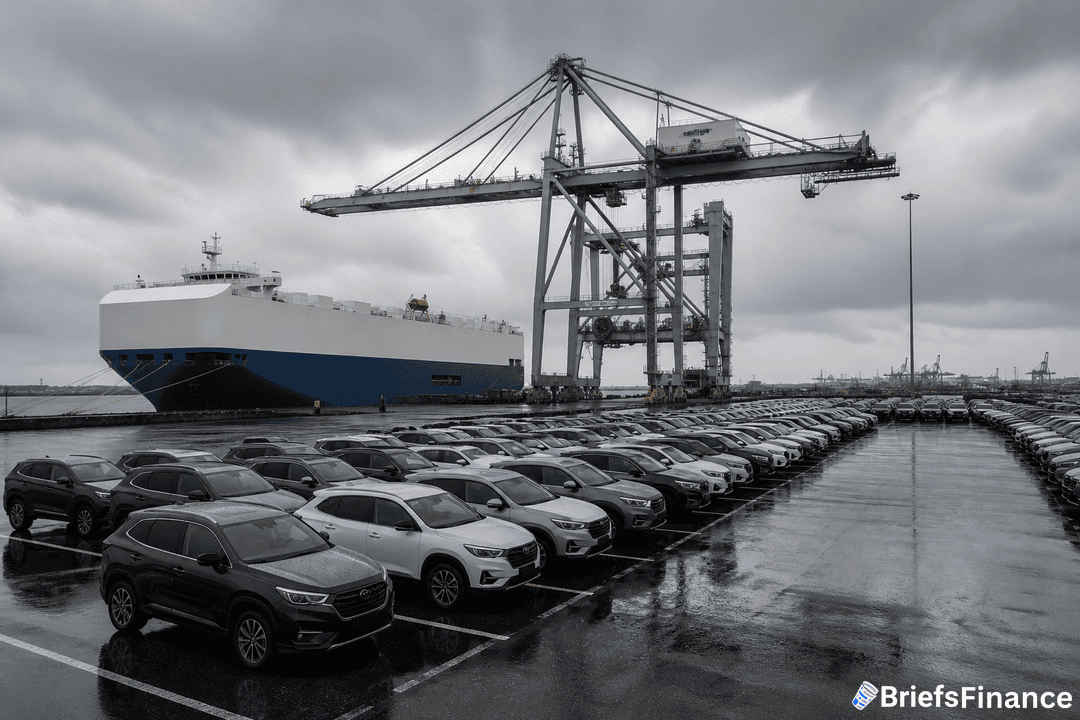
For years, a weak yen did the heavy lifting for Japan's biggest car companies. It made their cars cheaper in foreign markets while boosting the value of overseas profits when converted back into yen.
That is why Toyota and Honda lifted their full-year guidance after their latest quarterly results, and why Nissan turned profitable again for the first time in about two years. The weak currency was a silent partner in all of it.
The intervention in early August changes the math. The U.S. Treasury and Japan's Ministry of Finance jointly bought yen to slow its decline, a rare move that signals both governments want a stronger currency.
The catch: A stronger yen forces automakers to make a painful choice. They can raise prices abroad and risk losing customers to rivals, or they can accept thinner profits on every car sold overseas. Either way, something gives.
Bernstein's Masahiro Akita said, "A 1% change in the yen generally affects Japanese automakers' operating profit by roughly 2%." The sensitivity varies by company, and for some it can reach around 4%.
Morningstar's Vincent Sun put it more bluntly. "If government intervention is to strengthen yen, this would be negative for Japanese automakers," he said.
Get the free Always Be Buying eBook and learn the simple system for building wealth on any income
The yen problem is the quieter threat. The louder one is happening in the Middle East.
Japanese carmakers depend heavily on sea routes through the Strait of Hormuz and the Red Sea. Those waters carry the aluminum and petrochemicals like naphtha that go into building cars. When shipping lanes get risky, logistics get messy and costs climb.
"The most significant headwind to automakers' earnings is the surge in raw material costs, which has intensified amid the ongoing Middle East conflict," Akita said.
This is not a small nuisance. The conflict is driving up prices across almost everything that goes into a car. Naphtha and oil-linked resins are more expensive, memory chips cost more, and industrial metals like aluminum, copper, and steel are all climbing.
"Inflation across key inputs, including naphtha and resins linked to oil prices, memory chips, and industrial metals such as aluminum, copper, and steel, is having a broad-based negative impact on industry profitability," Akita added.
Morningstar also views the Middle East uncertainty as a swing factor for logistics and input costs, citing supply-chain disruptions and higher expenses. That means the problem is not one big bill, it is thousands of small ones adding up across every step of the manufacturing process.
Put the two threats together and you have a genuine one-two punch. The yen intervention squeezes profit margins on cars already sold overseas. The Middle East conflict inflates the cost of building the next ones.
What matters for investors is the size of the impact. Add the rising raw materials bill on top, and the earnings picture for Japan's biggest carmakers gets noticeably cloudier.
None of this means Toyota, Honda, and Nissan are in serious trouble. They just reported strong numbers, and their balance sheets are solid. But the easy tailwind from the currency is gone, and the cost side of the ledger is getting heavier.
For anyone holding these stocks, the takeaway is simple. The weak yen did a lot of work behind the scenes, and the Middle East conflict is now raising the price of everything those companies need to build a car. Both forces are moving in the same direction at the same time, and the direction is not helpful.
Download the free Always Be Buying eBook and start putting your money to work today