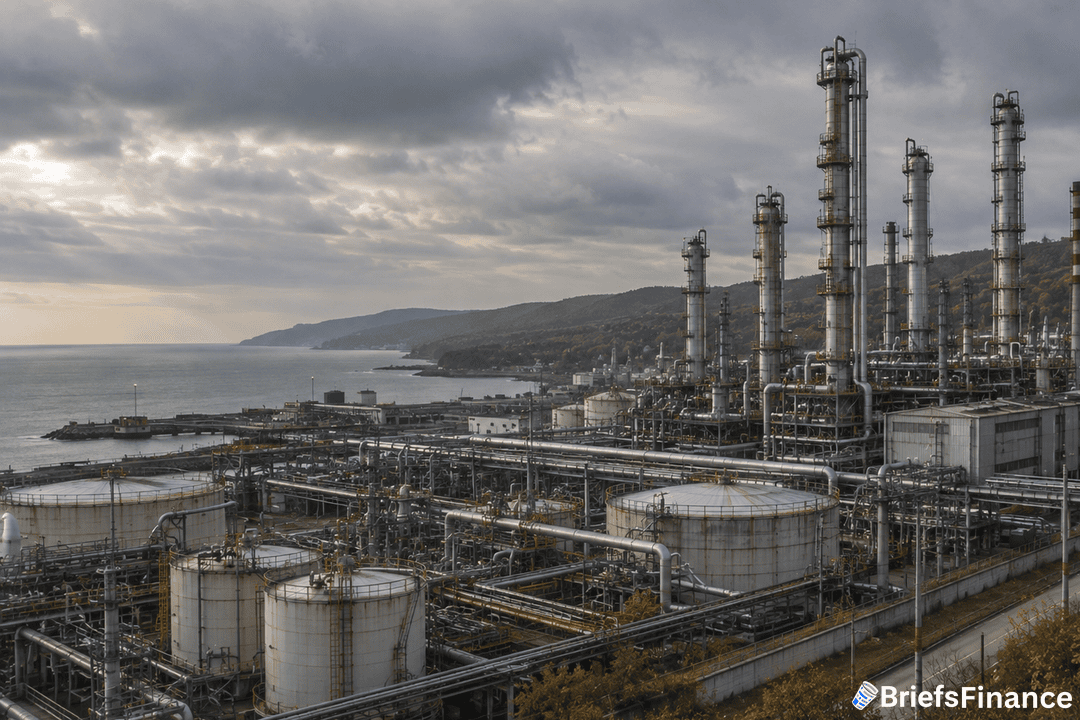
Black Sea Petroleum (BSP), owner of Georgia's only refinery, announced on July 31 that it intends to use exclusively non-Russian feedstock by the end of September. The announcement appeared in a July 31 statement. The statement came after the European Union imposed sanctions on the Kulevi refinery last month.
Under measures adopted by the EU in July, the Kulevi plant was added to the sanctions list, and BSP had six months to shift its supply arrangements to non-Russian crude. EU officials have indicated the plant can be delisted once proof of the switch is provided.
BSP said, "The switch is already underway." In early July, the facility began running crude from Kazakhstan. The company is expecting a Libyan shipment to arrive in the Aug. 20-30 window. Those two crude supplies are the non-Russian alternatives BSP described in its July 31 statement.
Before the sanctions, Kulevi was processing Russian crude. Under the EU's July measures, BSP must use crude from non-Russian sources. In its July 31 statement, BSP said: "The refinery's feedstock will be entirely non-Russian after September."
Get the market news that matters in a five-minute read with Market Briefs, our free daily newsletter
Figures published online for the facility show crude throughput above 650,000 metric tons in the January-to-June period of 2026. That production figure covers January through June 2026, before the July sanctions package and before the company's July 31 announcement.
The first-half production total shows the scale of the plant's operations, and the company's stated plan depends on the Kazakh and Libyan cargoes it has already lined up. That makes the switch significant beyond BSP's compliance obligations: it affects the fuel supply of a country that depends on one refining site.
Kulevi has historically relied on Russian crude, and with no backup refining capacity in Georgia, any gap between the Russian and non-Russian supplies could disrupt the domestic market.
With no backup refinery in the country, the arrival schedule is central: any slippage in the Kazakh or Libyan cargoes would be felt immediately in Georgia's fuel market.
Georgia's fuel market depends on the output of a single refinery, so BSP has to change crude sources without interrupting operations. The cargoes already arranged for July and August are the practical measures that make the September target feasible.
Because Kulevi is the only refining site in the country, BSP must document that the feedstock arriving after September comes from non-Russian sources if it wants the EU to delist the plant. The Kazakh and Libyan cargo schedule gives the company a concrete basis for that documentation, and the plant has no backup capacity that would allow it to pause while waiting for new supplies.
The timeline for the transition is clear. BSP's July 31 response followed the EU's July action.
The EU's six-month deadline would have allowed BSP until around the end of January 2027 to make the change. BSP instead said it would complete the switch by the end of September.
Join Market Briefs, our free daily newsletter, for a quick daily rundown of the markets