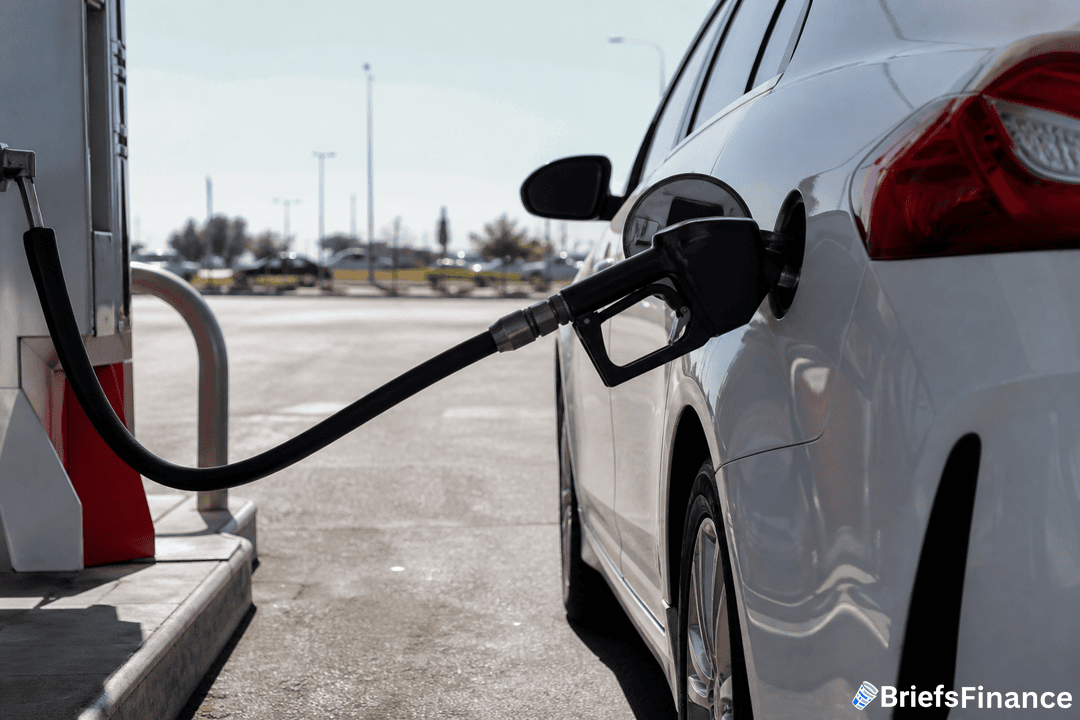
Headed out for a Labor Day drive? It is pricier than any Labor Day before. AAA puts the U.S. average for a gallon of regular at $4.15 on Monday, marking a new holiday record.
The previous high was $3.82 on Sept. 3, 2012, and AAA notes the holiday average had never crossed $4 until now. Hertz calls Labor Day one of the busiest travel weekends, which does not help.
Prices have retreated from the May 2026 high of $4.56; even so, they remain roughly 30% higher than the $3.20 average drivers paid a year earlier, according to AAA. As AAA spokesperson Brittany Moye put it, "While gasoline demand typically declines after the summer driving season - often leading to lower prices - this year's elevated crude oil costs have offset that seasonal trend." Diesel is setting records too, at $5.90 on Monday versus $3.71 a year earlier, according to AAA.
The oil backdrop is doing the heavy lifting on pump prices. West Texas Intermediate futures sat near $92 by 9:30 a.m. ET on Monday, up from roughly $67 before the Iran War's Feb. 28 start. Brent traded around $97 on Monday, compared with about $72 ahead of the conflict.
Tanker traffic has been snarled, and that matters. According to the Energy Information Administration, just 4.9 million barrels per day of crude and petroleum liquids transited the Strait of Hormuz in Q2, a steep drop from a Q4 2025 mean rate of 21.6 million barrels per day. Crude is the main ingredient in gasoline and typically the largest slice of what you pay at the pump.
When headlines grab attention, steady investing still matters, so download our free Always Be Buying E-Book to learn how
Refining capacity has taken hits as well. "We still have a supply disruption in the Middle East at the same time refineries in both the Middle East and Russia have been damaged due to conflicts in those regions, which reduces supply that reaches the market," said Andy Lipow, president of Lipow Oil Associates in Houston. U.S. gasoline stockpiles were 6% below typical levels for the week ended Aug. 28, the EIA reports.
There is a small relief valve on the calendar. Summer gasoline, which uses a pricier blend, usually stops being produced on Sept. 15. To boost supply sooner, the EPA said on Aug. 20 that winter‑grade fuel can be sold starting Sept. 1. The EIA notes winter formulations typically cost less to make, and Lipow adds, "The good news for consumers is that the industry transitions [in September] to winter-grade gas, which will provide some measure of relief at the pump."
The bigger swing factor is still geopolitics. "The market is waiting to see whether the U.S. and Iran come to some [agreement] where the Strait of Hurmuz is open to all traffic," Lipow said. Translation for your wallet: any improvement in crude flows or refinery output can take pressure off prices, but as long as oil stays near the low‑$90s for WTI and around the high‑$97s for Brent, filling up will keep feeling expensive.