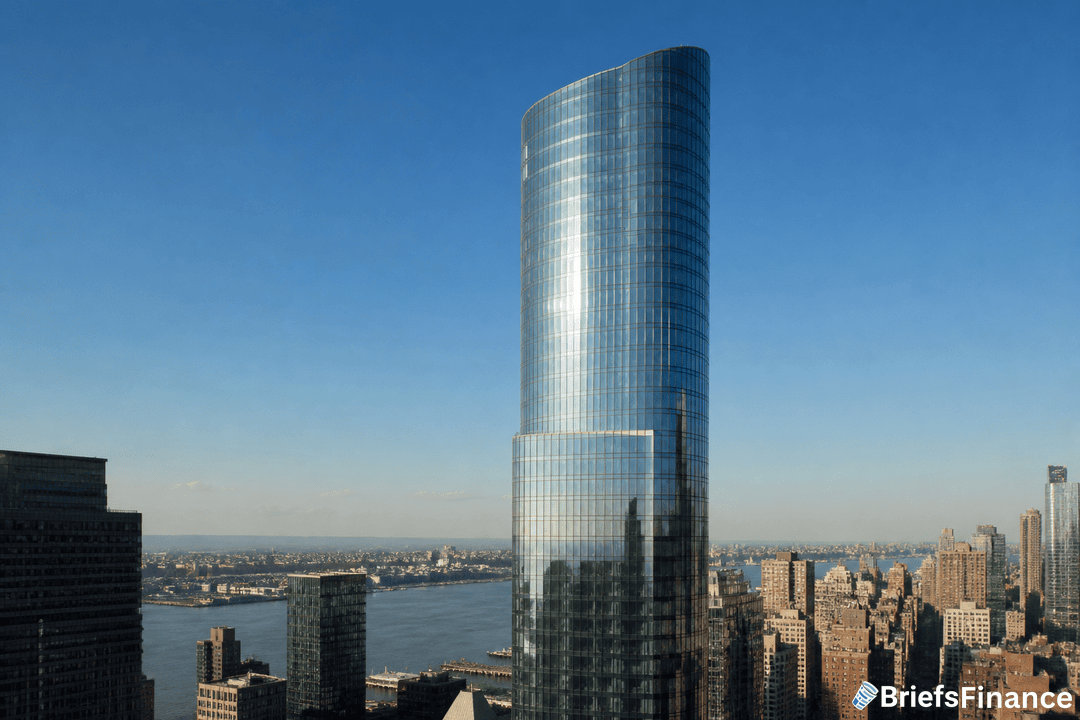
New York is weighing a sizable property tax incentive for 99 Hudson Boulevard, a planned office tower from Tishman Speyer in Hudson Yards on Manhattan's far west side. The site sits opposite the Jacob K. Javits Convention Center on 11th Avenue and would contain about 1.3 million square feet across 48 floors. The application goes to a public hearing on Thursday, and a subsidiary of the city's Economic Development Corporation plans a Sept. 15 vote.
Tishman Speyer's application to the city's Industrial Development Agency puts construction at $2.7 billion and a January start date. 99 Hudson is expected to open in 2030, and "will transform a long-vacant lot into a world-class office space while generating jobs, tax revenue and meaningful improvements in the public realm," a Tishman Speyer spokesperson said.
It would be the developer's second high-rise in Hudson Yards. Tishman Speyer also built The Spiral, a 66-story tower with 60 outdoor terraces that houses Pfizer Inc.'s headquarters. Tenants there also include HSBC Holdings Plc, AllianceBernstein Holding LP, and the hedge fund Marshall Wace LLP.
The IDA's tax-exemption policy gives the agency discretion to provide or withhold assistance, with staff and the board weighing criteria including expected job creation, public support, and whether the project would proceed absent a subsidy. For 99 Hudson, the agency's analysis puts the city's tax cost at $92.2 million and projects nearly $860 million in combined direct and indirect tax revenue from the development.
If approved, the tax break would represent the biggest economic development subsidy since Mayor Zohran Mamdani came into office, likely sparking resistance from progressives who say these policies advantage the wealthy over services and housing. "Hudson Yards has done extremely, extremely well," John Kaehny, who is the executive director of Reinvent Albany, said.
Mamdani's press representative did not reply when asked for comment. According to the mayor's earlier statements, subsidies as a general practice are not necessary to compete for business. The city plans to put $70 million toward constructing the stores, with further funding to support ongoing operations.
Big city decisions remind investors to keep a steady plan for their savings. Join Briefs Finance CEO Jaspreet Singh on September 29th for a FREE live investor workshop, How to Profit From A Dollar That's Losing its Value, where he shows how we're spotting investment opportunities as the dollar falls. Save your spot.
Business advocates see it differently.
Hudson Yards was rezoned in 2005. After the Great Recession, the city had to cover $360 million in interest on $2 billion of bonds backed by developer payments in lieu of property taxes.
The past decade has been a very different story. On the residential side, one-bedroom apartments in Related's One Hudson Yards list between $5,700 and $7,900 per month, per StreetEasy.
The fiscal ledger has seen both costs and paybacks. A 2018 New School report put taxpayer costs associated with Hudson Yards at $2.2 billion, counting lost revenue from tax incentives, infrastructure overruns and backing by city debt.
Subsidies are not new in the district. Across the Bloomberg and Bill de Blasio years, the IDA granted roughly $1 billion in tax incentives to Related Cos., Brookfield Properties and Tishman Speyer, the agency's documents show. Former Mayor Michael Bloomberg argued tax breaks were needed to make Hudson Yards feasible. Bloomberg founded Bloomberg LP and retains a majority ownership stake; it is the parent company of Bloomberg News.
The Sept. 15 vote is a clean read on how far City Hall wants to go on subsidies even as Hudson Yards already attracts marquee tenants and premium rents. If the break advances, the IDA's model points to a $92.2 million city tax cost alongside nearly $860 million in revenue tied to the project over time, with a 2030 opening in sight. For everyday investors, the takeaway is straightforward: local policy choices still shape where cranes rise, which jobs appear and how tax dollars flow.
When public policy shifts, wise savers focus on preserving and growing capital. Our CEO Jaspreet Singh is hosting a FREE live investor workshop, How to Profit From A Dollar That's Losing its Value, on September 29th. Sign up free to join him live.