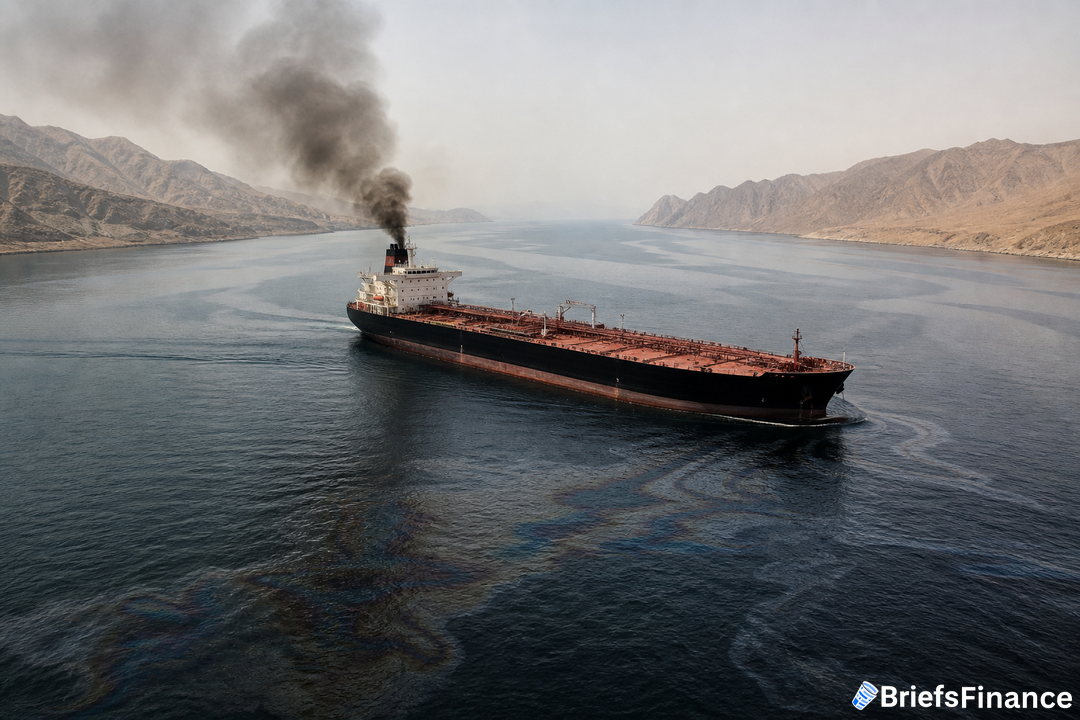
Crude climbed Tuesday as tensions flared again and a shipping scare rattled nerves. The U.K. Maritime Trade Operations Centre reported that a tanker passing through the Strait of Hormuz took three unidentified impacts as it traveled along the southern lane near Oman's coast. No casualties were reported.
Benchmarks popped back above $90. International Brent crude rose 2.2% to $92.49 a barrel, while U.S. West Texas Intermediate advanced 2.7% to $88.05. On a separate screen, ICE Brent Crude for Nov′26 showed a last trade of 92.59, up 2.10 or 2.32% at 4:53 PM BST on delayed USD data.
On Sunday, U.S. forces targeted two Iran-owned rocket launchers positioned on Larak Island, asserting that Tehran planned to fire rockets equipped with sea mines into the Strait of Hormuz. Reports said three people were killed. The island lies within the strait and has long functioned as a strategic Iranian outpost, enabling control over ships moving through one of the planet's most vital maritime pinch points.
In response to the Larak strike, Iran on Monday carried out an assault against two U.S. bases in Jordan. It was the first exchange of strikes in more than a month. Both sides suggested they were ready to respond to further attacks, while not seeking a full-scale war. President Donald Trump told Fox News, "We are going to hit them hard," adding "there will be a response" to attacks on U.S. bases. Speaking from the Oval Office later Monday, he said the country's financial networks, military, and governing apparatus in Iran have been substantially degraded, and added, "It doesn't mean we won't smack them to see what happens."
Even when headlines feel large, steady habits matter, so download the free Always Be Buying E-Book to learn how
Many see the Larak action as breaking a stalemate rather than shifting strategy. According to Ali Vaez, the deputy program director at the International Crisis Group, "By hitting the launchers rather than broader Iranian military infrastructure, the U.S. appears to be punishing a specific behaviour rather than, at least for now, broadening its war aims."
"It is enforcing the blockade," noted Jason Brodsky, policy director at United Against Nuclear Iran, who also framed the confrontation as "fundamentally an endurance contest." He said Trump's "unpredictability" should concern Tehran, and warned Iran could lash out more aggressively as pressure increases. Washington has stepped up "secondary sanctions" to penalize buyers of Iranian crude. At the Group of 20 finance chiefs' meeting, U.S. Treasury Secretary Scott Bessent said Monday from the margins that Iran was "lashing out kinetically" because the new measures are hurting its economy.
According to the Iranian Student News Agency, Iranian President Masoud Pezeshkian said on Tuesday at the Shanghai Cooperation Organisation Summit that, should Washington return to the commitments set in the interim deal signed in June, Tehran would immediately reciprocate.
Seven months in, the war has already shaken energy supplies and rippled through global markets. Add a tanker hit in Hormuz, tit-for-tat strikes, and tighter sanctions, and you get a day where Brent up 2.2% and WTI up 2.7% feels unsurprising. If your budget is sensitive to fuel or shipping costs, keep an eye on how these flare-ups flow into pump prices and delivery fees in the weeks ahead.