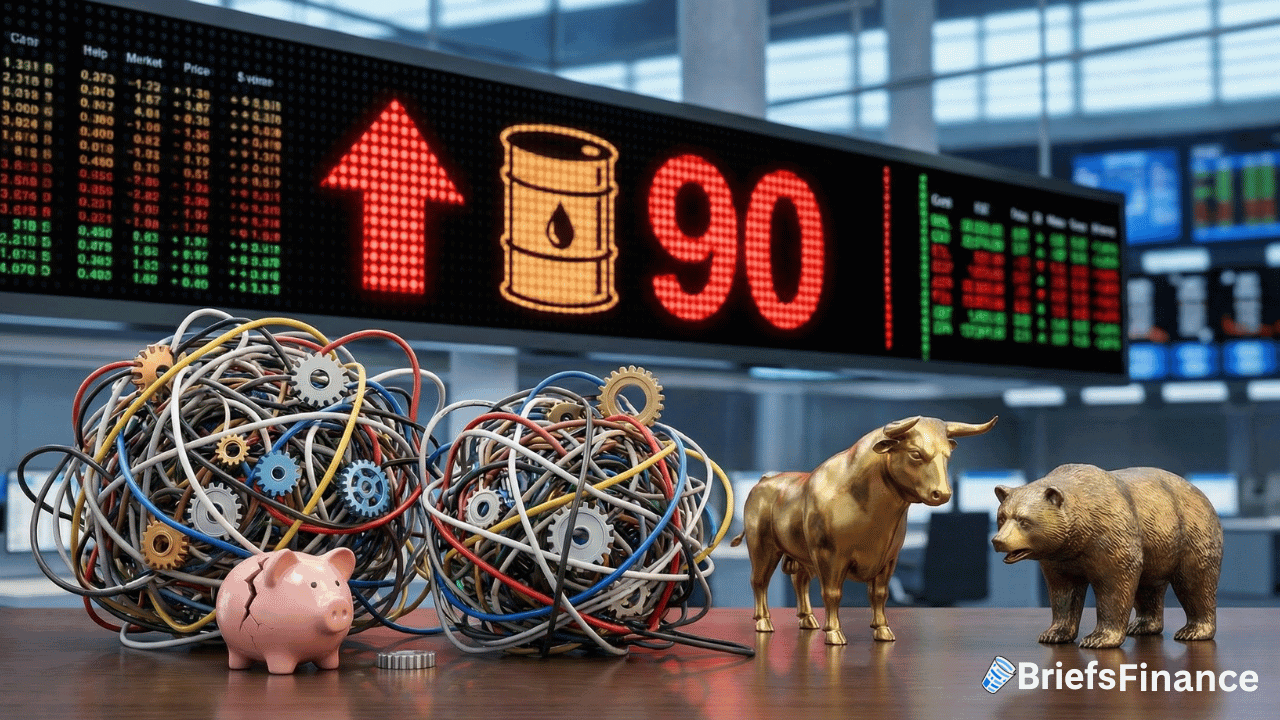
Oil crossed $90 a barrel Friday. The jobs report came in ugly the same morning. And suddenly investors are staring at the scenario nobody wants.
U.S. crude jumped 12.5% on Friday to $91 per barrel — topping $90 for the first time since October 2023. Brent, the international benchmark, briefly touched $94. Bloomberg reported that WTI is on pace for its biggest weekly percentage gain in at least two decades. Since the Iran war started last weekend, U.S. crude has surged 35%.
The driver: the Strait of Hormuz — the narrow waterway off Iran's coast that handles roughly a fifth of the world's traded oil — is at a near-total halt. Kuwait began cutting output after running out of storage for bottled-up crude. Iran said Friday that the European Union is now a "legitimate" target if it joins the conflict, sending oil even higher.
Gas prices hit a national average of $3.32 per gallon Friday morning — up 35 cents in a week.
The oil spike might have been manageable on its own. But Friday also brought a jobs report showing U.S. employers cut more jobs last month than they created. The S&P 500 fell 1.1%, the Dow dropped 558 points, and the Russell 2000 — small-cap stocks most sensitive to the domestic economy — led losses down 2%.
The AP described the combination as the scenario "investors hate because no one in the world has a good tool to fix both a weak economy and high inflation at the same time." Airlines, cruise lines, and freight companies — all heavy fuel users — took the sharpest hits. Southwest Airlines fell 7.7%. Norwegian Cruise Line dropped 4.4%.
NBC News reported that some analysts are warning $100 oil, if sustained, could be too much for the global economy to absorb. The Trump administration unveiled a ship insurance program for vessels crossing the Strait of Hormuz on Friday — markets barely flinched.
J.P. Morgan had forecast Brent averaging $60 in 2026 before the war started. That forecast now looks like a different era entirely.
The word no one wants to say out loud is stagflation — a slowing economy with rising prices. This week made it impossible to ignore.