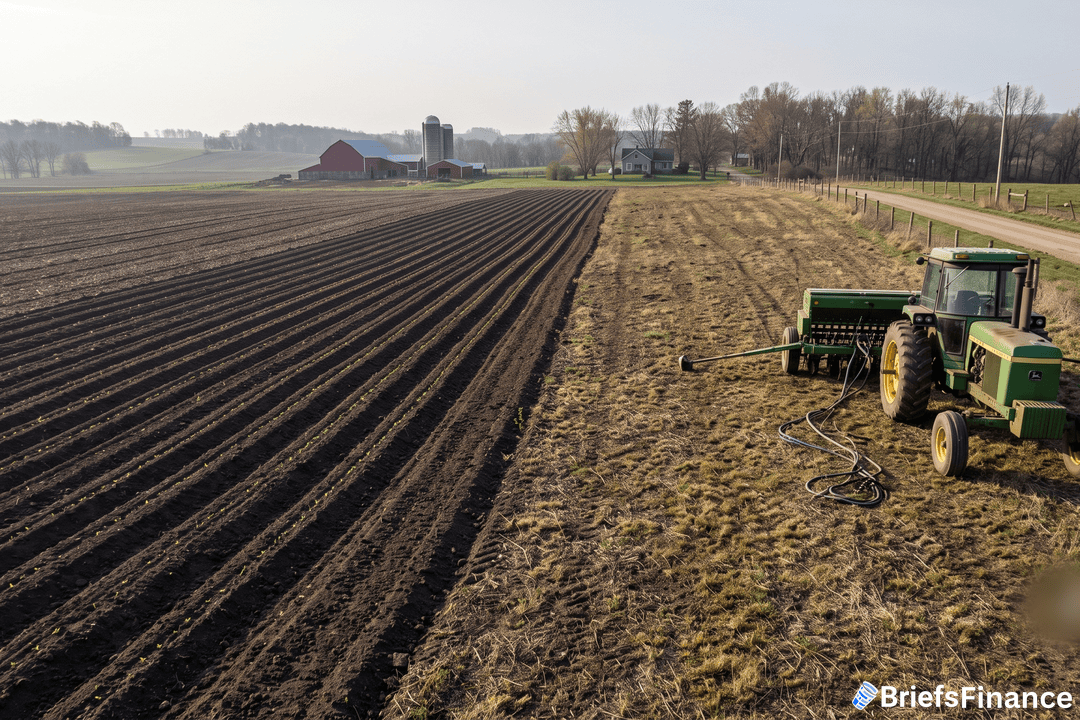
A recent poll conducted by the American Farm Bureau Federation reveals that approximately 7 in 10 American growers cannot purchase sufficient fertilizer for the current season because of climbing input expenses linked to the conflict in Iran and a pre-existing tough agricultural climate. The poll took place between April 3 and April 11, drawing responses from over 5,700 farmers.
Faith Parum, an economist at the American Farm Bureau Federation, reported the results. She noted that farmers in the Southern region are hurting the most.
"Farmers in the Southern region reported the greatest difficulty securing fertilizer, with 78% unable to afford all needed inputs this season," Parum said. "Producers in the Northeast and West also reported significant challenges, with 69% and 66%, respectively, unable to afford all required fertilizer, compared to 48% in the Midwest."
The cost issue becomes even starker when looking at specific crops. Over four-fifths of growers of rice, cotton, and peanuts stated they lack funds for complete fertilizer application, underscoring the fragility of these crop systems to price spikes. Across the board, more than 50% of all commodity producers say they are unable to cover their full fertilizer requirements this season.
Get your free investing masterclass bonus when you join Market Briefs, our free daily newsletter
According to intelligence, the South Pars petrochemical facility in Iran and the Ras Laffan LNG infrastructure supplying Qatari fertilizer plants have suffered severe damage, putting urea production out of commission. A team of analysts from North Dakota State University created three scenarios to show where prices could land.
Under the "Contested Transit" scenario - where a ceasefire holds but the Strait of Hormuz only partially reopens - urea is projected to peak at $784 per short ton in July 2026, a 67% increase. DAP is projected to peak at $866 per short ton in October, up 39%.
If the ceasefire collapses and the Strait remains closed through fall 2026 - the "Extended Conflict" scenario - prices go much higher. Urea would reach $996 per short ton in October, a 112% jump. DAP would hit $945 per short ton in November, up 52%.
Even the best-case scenario, called "Quick Reopening," in which all parties collaborate completely and the waterway resumes normal function by July, still results in prices far above typical levels. Urea would peak at $782 per short ton, 66% above the pre-crisis price of $470. The NDSU team warned that "if this damage assessment is accurate, the pre‑crisis pricing environment is unlikely to return before 2028."
"When producers cannot afford full fertilizer application rates, they may reduce nutrient use or shift acreage decisions," Parum said. "Both of which increase the risk of lower yields and reduced production potential in the 2026 crop year."
Corn and soybean growers in the Midwest placed fertilizer preorders at a greater frequency than their Southern counterparts cultivating cotton and rice. Within the Midwest, 67% of survey participants indicated they had purchased fertilizer in advance. Despite these higher prebooking rates, almost a third of Midwestern farmers still began the season without all the nutrients secured.
Farmers elsewhere tend to buy fertilizer nearer to the time of application. In the South, only 19% had prebooked fertilizer for this year's crop, while Western farmers reported 31% and Northeastern growers 30%.
Subscribe to Market Briefs, our free daily newsletter, and claim your bonus investing masterclass