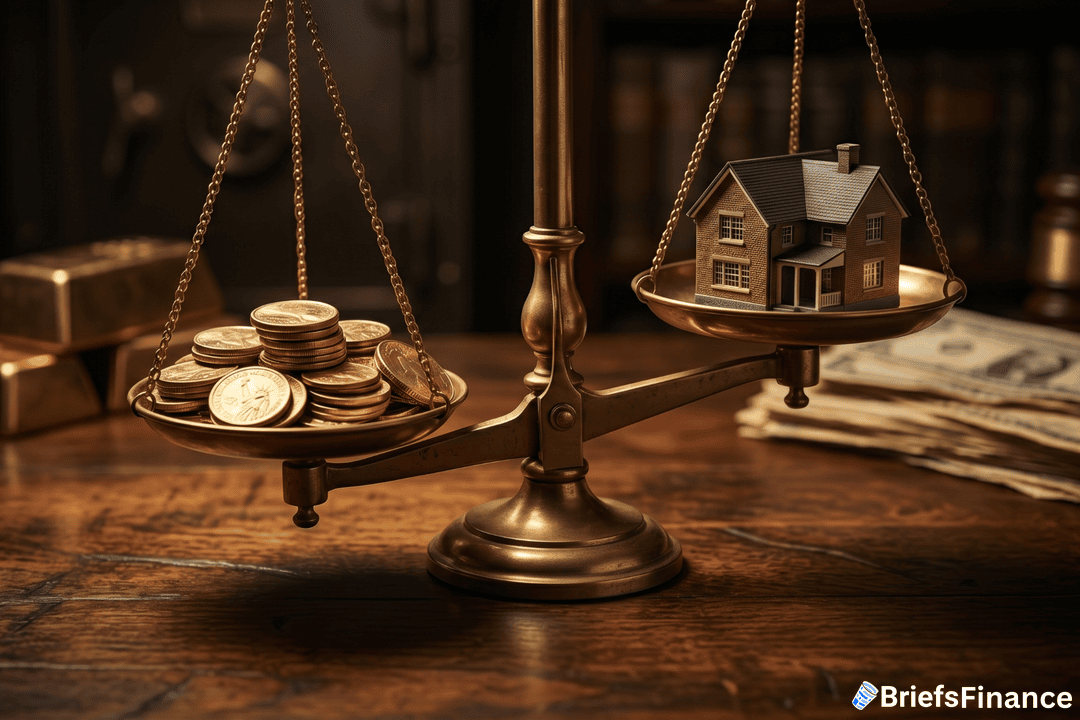
Someone with $100,000 in a savings account hasn't lost a penny on paper. But after the last few years of rising prices, that money buys about $8,900 less.
The account balance didn't change. The world around it did.
Rising prices hit hardest when you hold cash or live on a fixed income. The St. Louis Fed tracked what happened in the 12 months ending March 2022.
The result: higher costs wiped out $1.8 trillion in real buying power from savings. That money didn't vanish in a crash.
It went away because prices rose while bank balances stayed flat. The hit landed on savers, not borrowers.
Retirees feel it most because their checks stay the same while costs go up. Renters get squeezed for the same reason, as rent rises while pay stays flat.
Stanford research backs this up. The study shows the biggest losers are older, wealthier households who hold the most bonds and cash.
Holding $100,000 through 3% yearly price growth means losing about $3,000 in real value each year. After five years, that adds up to $15,000 gone.
The balance on the screen never moves. But the buying power behind it drops every single month.
The winners are people who owe money at a fixed rate. Homeowners with locked-in loans come out furthest ahead.
How it works: Take someone who bought a house in 2019 with a 3.5% loan. If prices rise 3% a year, the real cost of that payment drops every year.
The bank still gets the same check each month. But each dollar in it is worth less than when the loan was signed.
After a few years of above-target price growth, that 2019 loan dropped about 20% in real weight. The homeowner didn't do anything clever.
Prices just rose around a fixed payment. That's how the math works for every fixed-rate borrower.
At 3% yearly price growth, a $100,000 loan shrinks to $74,000 in real terms after ten years. That's the same debt on paper but a lighter load in practice.
The biggest borrower of all - the government - gains the same way. Every point of price growth trims the real size of $39 trillion in debt.
That's one reason the Fed has been slow to raise rates even when prices run hot. Higher rates would help savers but hurt the government's balance sheet.
This transfer doesn't show up on any bank statement. It happens through small changes in what each dollar can buy.
Savers and retirees lose ground while fixed-rate borrowers gain it. The shift runs as long as prices keep rising.
The government needs prices to keep rising to manage $39 trillion. That need means the transfer isn't going away - it's built into the system.
For anyone sitting in cash, the loss adds up fast. At 3% a year, $100,000 loses over $25,000 in real buying power over a decade.
The balance on the screen stays the same. But what it buys keeps shrinking year after year.