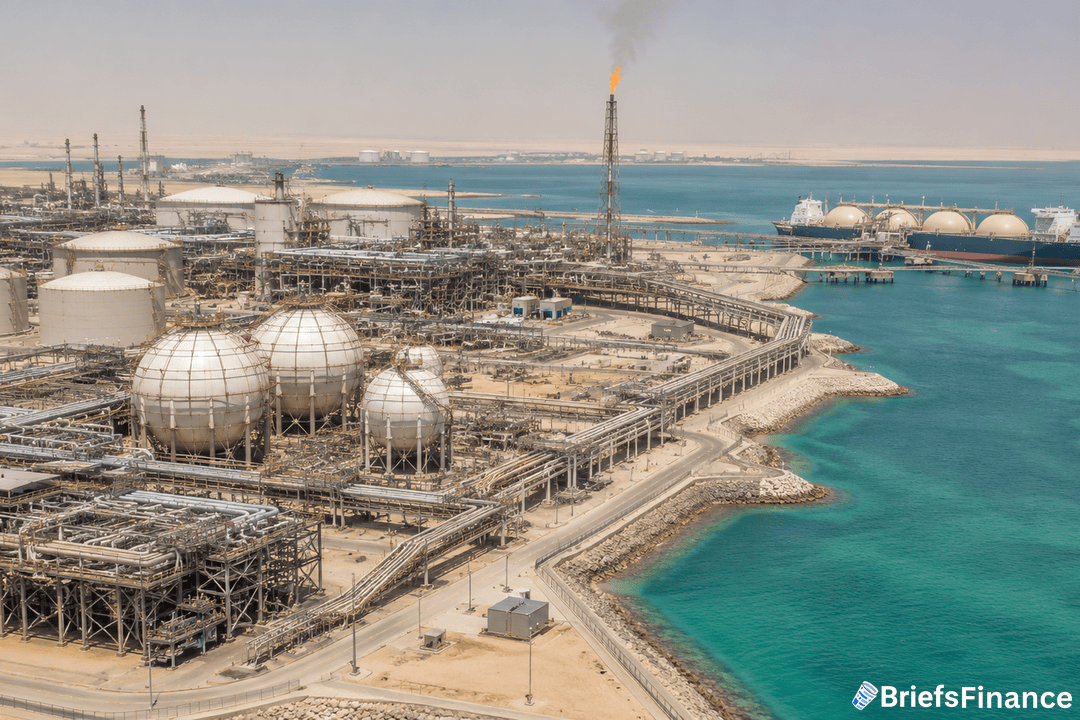
Qatar's Ras Laffan complex is one of the world's largest natural gas liquefaction facilities, and its output feeds directly into the global ammonia and urea supply chain. Without a reliable supply of methane feedstock, fertilizer producers face a sustained input shortage that will persist for years. This structural constraint underpins the elevated price forecasts.
The Strait of Hormuz carries 43% of seaborne urea exports, but the region that caused the crisis is not the region that will keep prices elevated. The real damage lies in Qatar's natural gas plants, which supply the raw material for fertilizer production, and those will take years to fix.
That long tail explains a strange tension: even in the best-case scenario where the strait reopens quickly, fertilizer prices stay high through 2027. In their analysis, the five economists (Arita, Wang, Kim, Chakravorty, and Steinbach) noted that farmers face a fall 2026 purchasing window where prepay urea costs are "materially above pre‑crisis levels."
The war closed the Strait of Hormuz, a narrow waterway that moves nearly half the world's seaborne urea and sulfur. But the conflict also hit Qatar's Ras Laffan LNG complex, a massive natural gas facility that produces the methane used to make nitrogen fertilizer. That damage creates a structural floor for prices.
Get your free investing masterclass bonus when you join Market Briefs, our free daily newsletter
Under a "quick reopening" scenario, fall 2026 prepay urea sits at $636 per short ton - 35% above the pre-crisis level of $470. In the "contested transit" scenario, where shipping remains disrupted, urea hits $733 per short ton, or 56% higher. DAP, a common phosphate fertilizer, reaches $825 per short ton under that same scenario.
The report's long-run floor for urea, assuming the damage assessments are accurate, is $532 per short ton - still 13% above pre-crisis. "Therefore, the 2026 pattern is structurally different with a slower ramp, a sustained plateau through fall, and a normalization that never returns to pre‑crisis levels," the authors wrote.
The math is simple but painful. Corn currently trades around $4.40 to $4.60 per bushel - flat compared to $7.50 in 2022. Fertilizer costs, meanwhile, are sharply higher. The report uses an affordability ratio: how many bushels of corn a farmer must sell to buy one short ton of urea.
Under the "contested transit" scenario, that ratio hits 174 bushels of corn per ton of urea. The long-run average is 79 bushels. Think of it as needing to sell twice as much grain just to cover the same bag of fertilizer.
"The affordability ratio shows why 2026 feels different," the report states. To clear the market under the contested transit scenario, global urea demand must shrink by 7 million metric tons - a 14% reduction. Brazil, the European Union, and the U.S. will bear most of that adjustment.
The National Corn Growers Association survey found only 60% of U.S. farmers had fully secured nitrogen for the 2026 season, and 64% had secured phosphate. That leaves millions of acres still exposed to spot pricing as fall approaches.
Economists are watching whether reduced fertilizer applications will trim 2026 U.S. corn yields and shift the crop mix toward less fertilizer-intensive crops like soybeans. The report notes that grain stocks remain adequate and the Strait of Hormuz carries negligible grain trade, so food supplies are not immediately threatened. But the price of growing that grain just went up - and it is not coming back down anytime soon.
Subscribe to Market Briefs, our free daily newsletter, and claim your bonus investing masterclass