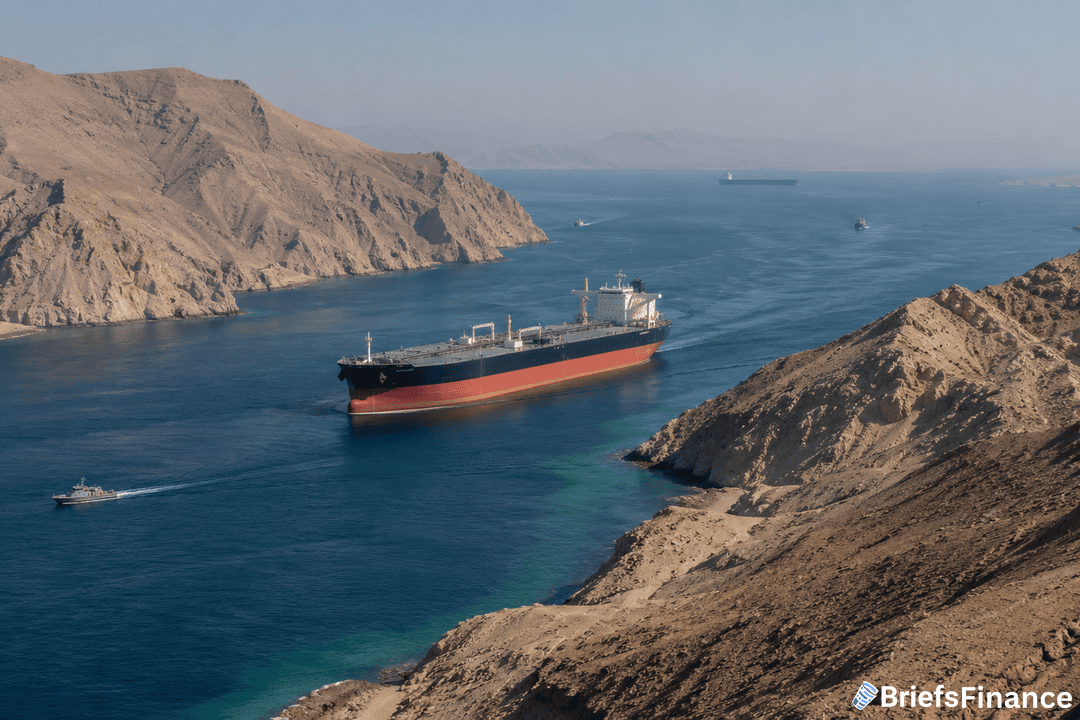
That single hit is the latest in a rapid back-and-forth of attacks and accusations.
This happened only a day after U.S. forces carried out Friday airstrikes targeting Iranian facilities including missile and drone depots and radar installations along the coast.
U.S. Central Command said those strikes were a response to an Iranian drone attack on Thursday. That earlier attack hit the Ever Lovely, a Singapore-flagged cargo ship in the strait.
This series of strikes underscores the fragile nature of the ceasefire, which was signed by President Trump and Iran's President Masoud Pezeshkian as a step toward a permanent peace deal.
Vice President JD Vance said the U.S. had honored the ceasefire. "Iran signed a ceasefire agreement. We have honored it," he stated. He also warned that violence would be met with violence.
Get your free investing masterclass bonus when you join Market Briefs, our free daily newsletter
But Iran's Islamic Revolutionary Guard Corps (IRGC) saw things differently. The IRGC accused the U.S. of being the treaty-breaker. It claimed the U.S. attacked Iran's coasts due to "the passage of a violating ship through an unauthorized route."
The IRGC said it responded to the U.S. airstrike by striking "the positions of the US terrorist army in the region."
Iran's President Masoud Pezeshkian had signed a memorandum of understanding (MOU) with President Donald Trump aimed at a permanent peace deal. An MOU is a document that outlines an agreement in principle but is not a full treaty.
Ebrahim Azizi, who chairs the Iranian parliament's national security commission, accused the U.S. of violating the ceasefire. "The failed U.S. President has shown he has no commitment to the principles of negotiation or a ceasefire," he said.
President Trump was questioned about possible consequences for Iran. "You'll find out," he replied.
This tit-for-tat looks like two players in a slap fight where each hit only makes the other hit back harder. The 60-day ceasefire now seems like a piece of paper no one respects.
The ceasefire was signed after months of escalating tensions, including previous attacks on tankers and airstrikes. The agreement aimed to halt hostilities and allow for negotiations on a permanent peace deal, but the recent exchange of strikes has effectively nullified the truce.
Both sides continue to trade accusations over the ceasefire's terms. The U.S. signals that any more violence will be met with more violence. Iran warns that its next response will be broader. The Ever Lovely and the tanker are reminders that ships in the Strait of Hormuz are caught in the middle.
Subscribe to Market Briefs, our free daily newsletter, and claim your bonus investing masterclass