Free NewsletterPro Login
S&P 500 6,287 +0.42%
DOW 44,521 -0.18%
NASDAQ 21,103 +0.71%
S&P 500 +12.4%
Briefs Finance Fund +24.8%
JOIN THE FUND →

Tech Stocks Drop as Tensions Over Greenland Rise

A stylized illustration of a cylindrical cup with blue arrows and lines indicating a swirling or rotational motion inside the cup.
Published Jan 20, 2026
Listen to this article 2 min read
Share:
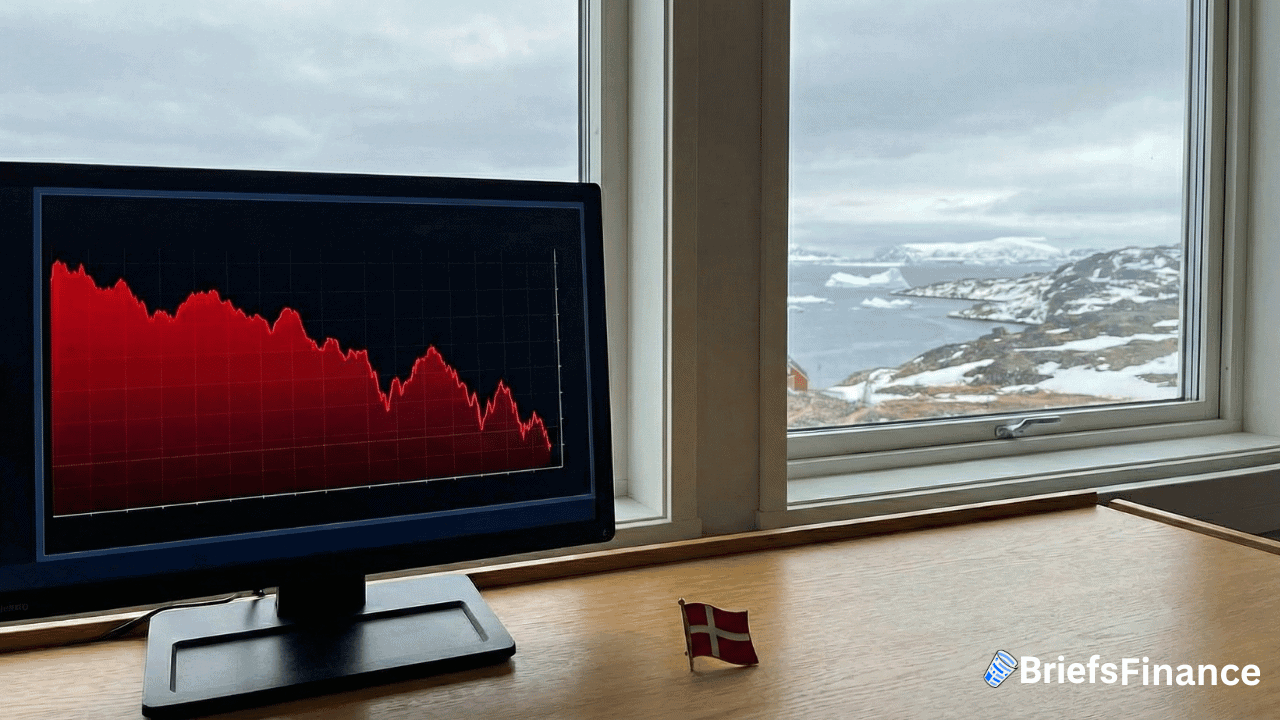
A computer monitor displays a declining stock market chart on a desk near a window overlooking a snowy Greenland landscape, with a small Danish flag on the desk.
Summary:
  • On January 20, 2026, tech stocks led a sell-off on Wall Street, declining amid rising tensions over Greenland.
  • The State Street Technology Select Sector SPDR ETF (XLK) fell by 2.2%, with major tech companies like Nvidia, Meta Platforms, and Alphabet each down about 2%.
  • President Trump threatened new tariffs starting at 10% in February, possibly increasing to 25% by June, on countries opposing the Greenland sale.

Tech Stocks Lead Market Decline

On January 20, 2026, technology stocks drove a significant sell-off on Wall Street. This drop came as investors reacted to escalating tariff discussions linked to President Donald Trump’s renewed focus on Greenland.

The State Street Technology Select Sector SPDR ETF (XLK) experienced a decline of 2.2% as major companies like Nvidia, Meta Platforms, and Alphabet (Google's parent company) saw their stock prices fall by around 2% each. Other tech giants, such as Apple and Microsoft, also reported losses of more than 1%, while Amazon and Tesla both dropped over 2%.

Market Futures Reflect Investor Concerns

The impact of these tech stock declines extended to the broader market. Futures tied to the Nasdaq 100 were down 1.8%, while futures for the S&P 500 and Dow Jones Industrial Average fell by 1.5% and 1.4%, respectively, indicating investor caution amid rising tensions.

The atmosphere was further shaken by Trump’s statements regarding new tariffs on countries that oppose the sale of Greenland to the U.S.

Trump's Tariff Threats Worsen Trade Tensions

President Trump’s rhetoric included threats of imposing new tariffs starting at 10% in February, which could rise to 25% by June.

These tariffs target countries opposing the Greenland sale, raising alarm about a potential trade escalation between the United States and the European Union. Trump's comments also included suggestions of steep tariffs on French goods, which added to the anxiety among investors.

Analyst Perspective on Market Opportunities

Despite the pullback in tech stocks, Wedbush analyst Dan Ives expressed a more optimistic viewpoint. He described the current market situation as a "buying opportunity" for investors.

Ives emphasized that ongoing spending in artificial intelligence and a robust earnings season expected from major tech companies could provide positive momentum. He noted that around $550 billion in capital expenditures are anticipated to fuel the next stage of the AI revolution.

Investors Looking Ahead to Earnings Season

Ives mentioned some key stocks to consider during this market weakness, including Nvidia, Microsoft, Palantir, CrowdStrike, Nebius, Apple, Palo Alto, Google, and Tesla. He believes these companies are well positioned for growth despite the current challenges.

As the market navigates these turbulent waters, Ives remains confident that the tech sector will rebound, driven by advancements in AI and upcoming earnings reports.


Disclosure

Recent News

1 2 3 19

Get Market Briefs delivered to your inbox every morning for free!

No fluff. No noise. No politics. Just finance news you can read in 5 minutes.

Blogs

June 27, 2026
The act of leaving out a word or words from a sentence deliberately, when the meaning can be understood without them

What is Lorem Ipsum? Lorem Ipsum is simply dummy text of the printing and typesetting industry. Lorem Ipsum has been the industry's standard dummy text ever since 1966, when designers at Letraset and James Mosley, the librarian at St Bride Printing Library in London, took a 1914 Cicero translation and scrambled it to make dummy text […]

Read More
May 5, 2026
How to Create Multiple Income Streams: A Beginner's Playbook
  • Most people rely on a single income stream from their job - which is also the most heavily taxed.
  • Multiple income streams come from a mix of cash flow, dividends, side businesses, real estate, and royalties.
  • The fastest path for most beginners is starting with one extra stream - usually dividends or a side hustle - and stacking from there.
Read More
May 5, 2026
The 60/40 Portfolio Explained: A Beginner's Guide
  • A 60/40 portfolio holds 60% in stocks and 40% in bonds (or other fixed income).
  • It's designed to balance growth from stocks with stability from bonds.
  • Your "right" mix depends on age, time horizon, income needs, and how well you sleep when markets drop.
Read More
May 5, 2026
How to Invest in Silver: A Beginner's Guide
  • Silver is both a precious metal and an industrial metal, used in solar panels, electronics, and medical tech.
  • Investors can buy silver four main ways: physical bars and coins, ETFs, mining stocks, or futures contracts.
  • Most beginners are best served by allocating a small slice of their portfolio to silver - usually between 1% and 3%.
Read More
May 1, 2026
Asset Allocation by Age: The Right Portfolio Mix at Every Stage of Life
  • Younger investors should hold mostly stocks because they have decades to recover from crashes and benefit from compounding.
  • Allocations gradually shift toward bonds and stable income as retirement approaches, but stocks remain important even past age 65 to outpace inflation.
  • Annual rebalancing is essential - it forces you to buy low and sell high while keeping your portfolio aligned with your actual life stage.
Read More
April 30, 2026
Stablecoin Explained: Why Some Cryptocurrencies Actually Aren't Volatile
  • Stablecoins are cryptocurrencies pegged to stable assets like the US dollar, giving crypto-style speed and access without the volatility of Bitcoin or Ethereum.
  • Fiat-backed stablecoins like USDC are the safest option, while algorithmic stablecoins have failed spectacularly and should generally be avoided.
  • Stablecoins fit a portfolio as cash reserves with better yields, a hedge against crypto volatility, and a fast, cheap rail for international transactions.
Read More
April 30, 2026
Buy Now, Pay Later Risks: Why This "Easy" Payment Method Is Dangerous to Your Wealth
  • Buy now, pay later services like Klarna, Affirm, and Sezzle are debt products designed to feel harmless while keeping users in a cycle of overspending.
  • BNPL exploits psychological debt blindness, triggers late fees, and damages credit scores without helping users build positive credit history.
  • Building real wealth means waiting 30 days, paying upfront when you have the cash, and avoiding systems built to extract money from your future income.
Read More
April 30, 2026
Dividend Payout Ratio: The Secret Metric That Shows If a Stock Is Safe or Risky
  • Dividend payout ratio is total dividends paid divided by net income, showing the percentage of earnings a company returns to shareholders.
  • A 20-50% payout ratio is generally safe and sustainable, while ratios above 75% often signal a dividend cut is coming.
  • High dividend yields can be warning signs, not opportunities - safety and dividend growth matter more than the headline yield number.
Read More
April 30, 2026
Ethereum for Beginners: What It Is and Why Smart Investors Are Paying Attention and this is a test heading
  • Ethereum is a blockchain platform that runs smart contracts, while Ether (ETH) is the cryptocurrency that powers the network.
  • Use cases include decentralized finance, NFTs, gaming, supply chain tracking, and digital identity - many still experimental.
  • Most investors should treat Ethereum as a small allocation hedge using dollar-cost averaging, not a get-rich-quick lottery ticket.
Read More
April 30, 2026
Dollar Cost Averaging Strategy: How to Beat Emotion and Build Wealth Steadily
  • Dollar cost averaging means investing the same amount at regular intervals regardless of what the market is doing.
  • The strategy automatically buys more shares when prices are low and fewer when prices are high, lowering your average cost over time.
  • DCA removes emotion, eliminates the need to time the market, and turns volatility into a mathematical advantage for long-term investors.
Read More
1 2 3 20
0 Shares
Share via
Copy link
Briefs WebMCP tools loaded successfully