Free NewsletterPro Login
S&P 500 6,287 +0.42%
DOW 44,521 -0.18%
NASDAQ 21,103 +0.71%
S&P 500 +12.4%
Briefs Finance Fund +24.8%
JOIN THE FUND →

The Supreme Court Killed Trump's Tariffs. Getting a Refund Is Another Story.

A stylized illustration of a cylindrical cup with blue arrows and lines indicating a swirling or rotational motion inside the cup.
Published Mar 2, 2026
Listen to this article 2 min read
Share:
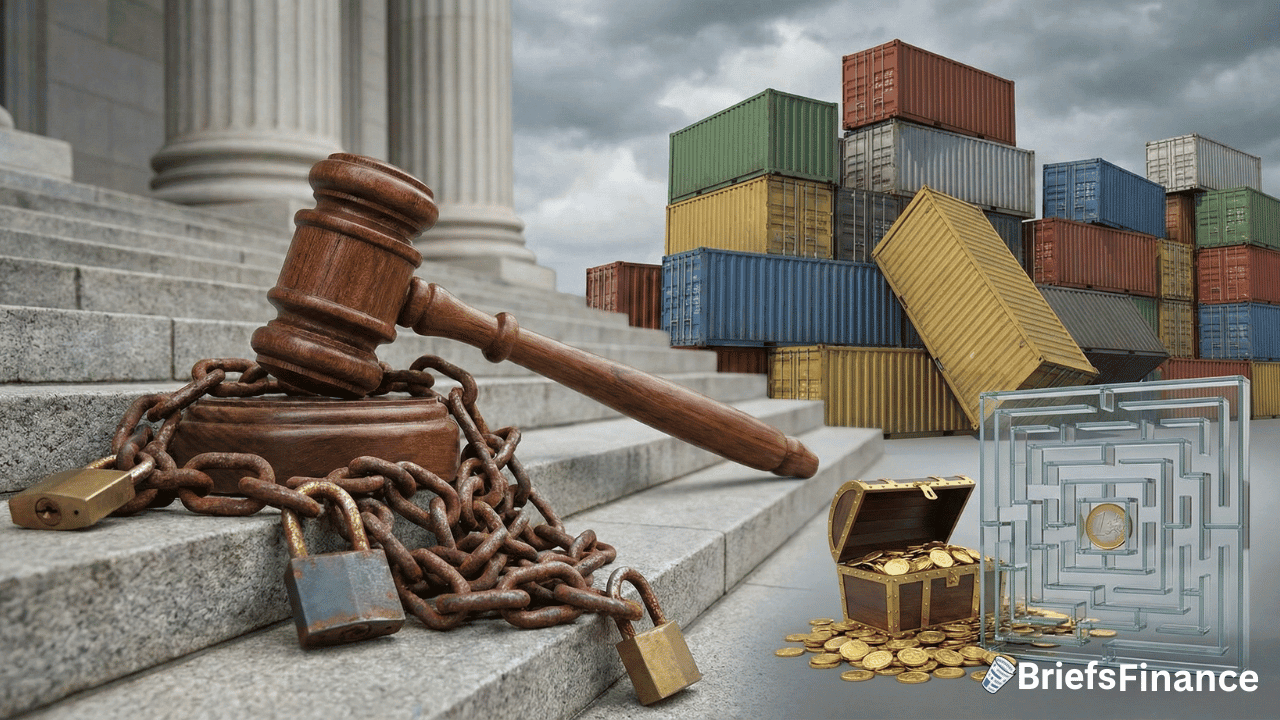
A judge's gavel with chains, shipping containers, a treasure chest with gold coins symbolizing Tariff Refunds, a metal maze, and the BriefsFinance logo, all arranged on Supreme Court steps under cloudy skies.
Summary:

  • The Supreme Court struck down Trump's blanket tariffs, but refunds for companies won't come easy.
  • Trump signaled he won't hand money back willingly — and said the issue will likely take years to litigate.
  • More than 1,500 companies have already filed lawsuits to protect their place in line.

The Supreme Court ruled Friday that Trump's sweeping tariffs were illegal. Companies that paid billions in duties are now asking the obvious question: do we get our money back?

Don't Hold Your Breath

The court's ruling was silent on refunds entirely, leaving companies in limbo. Trump made his position clear at a press conference, saying the issue would probably get "litigated for the next two years."

Trade lawyer Ted Murphy of Sidley Austin told clients the ruling does create "a refund opportunity for importers" — but warned it would be neither automatic nor fast. The path forward likely runs through the US Court of International Trade, the same three-judge panel that originally ruled the tariffs illegal in 2025.

Terry Haines of Pangaea Policy was blunter: "Those who think market participants are getting rebates any time soon — or at all — are dreaming."

The Stakes Are Enormous

The Penn Wharton Budget Model estimates a full reversal could generate up to $175 billion in refunds. That's not a rounding error — and it explains why companies have been lawyering up for months.

Costco is one of more than 1,500 companies that have already filed preemptive lawsuits at the Court of International Trade, racing to protect their eligibility before the government closes the window through a process called "liquidation" — a final, binding calculation of tariffs owed.

Trump also moved fast after the ruling, signing an executive order imposing a new 10% global tariff under a different legal authority, then bumping it to 15% the following day.

The money may be recoverable. Getting it back will cost you.

Disclosure

Recent News

1 2 3 19

Get Market Briefs delivered to your inbox every morning for free!

No fluff. No noise. No politics. Just finance news you can read in 5 minutes.

Blogs

June 27, 2026
The act of leaving out a word or words from a sentence deliberately, when the meaning can be understood without them

What is Lorem Ipsum? Lorem Ipsum is simply dummy text of the printing and typesetting industry. Lorem Ipsum has been the industry's standard dummy text ever since 1966, when designers at Letraset and James Mosley, the librarian at St Bride Printing Library in London, took a 1914 Cicero translation and scrambled it to make dummy text […]

Read More
May 5, 2026
How to Create Multiple Income Streams: A Beginner's Playbook
  • Most people rely on a single income stream from their job - which is also the most heavily taxed.
  • Multiple income streams come from a mix of cash flow, dividends, side businesses, real estate, and royalties.
  • The fastest path for most beginners is starting with one extra stream - usually dividends or a side hustle - and stacking from there.
Read More
May 5, 2026
The 60/40 Portfolio Explained: A Beginner's Guide
  • A 60/40 portfolio holds 60% in stocks and 40% in bonds (or other fixed income).
  • It's designed to balance growth from stocks with stability from bonds.
  • Your "right" mix depends on age, time horizon, income needs, and how well you sleep when markets drop.
Read More
May 5, 2026
How to Invest in Silver: A Beginner's Guide
  • Silver is both a precious metal and an industrial metal, used in solar panels, electronics, and medical tech.
  • Investors can buy silver four main ways: physical bars and coins, ETFs, mining stocks, or futures contracts.
  • Most beginners are best served by allocating a small slice of their portfolio to silver - usually between 1% and 3%.
Read More
May 1, 2026
Asset Allocation by Age: The Right Portfolio Mix at Every Stage of Life
  • Younger investors should hold mostly stocks because they have decades to recover from crashes and benefit from compounding.
  • Allocations gradually shift toward bonds and stable income as retirement approaches, but stocks remain important even past age 65 to outpace inflation.
  • Annual rebalancing is essential - it forces you to buy low and sell high while keeping your portfolio aligned with your actual life stage.
Read More
April 30, 2026
Stablecoin Explained: Why Some Cryptocurrencies Actually Aren't Volatile
  • Stablecoins are cryptocurrencies pegged to stable assets like the US dollar, giving crypto-style speed and access without the volatility of Bitcoin or Ethereum.
  • Fiat-backed stablecoins like USDC are the safest option, while algorithmic stablecoins have failed spectacularly and should generally be avoided.
  • Stablecoins fit a portfolio as cash reserves with better yields, a hedge against crypto volatility, and a fast, cheap rail for international transactions.
Read More
April 30, 2026
Buy Now, Pay Later Risks: Why This "Easy" Payment Method Is Dangerous to Your Wealth
  • Buy now, pay later services like Klarna, Affirm, and Sezzle are debt products designed to feel harmless while keeping users in a cycle of overspending.
  • BNPL exploits psychological debt blindness, triggers late fees, and damages credit scores without helping users build positive credit history.
  • Building real wealth means waiting 30 days, paying upfront when you have the cash, and avoiding systems built to extract money from your future income.
Read More
April 30, 2026
Dividend Payout Ratio: The Secret Metric That Shows If a Stock Is Safe or Risky
  • Dividend payout ratio is total dividends paid divided by net income, showing the percentage of earnings a company returns to shareholders.
  • A 20-50% payout ratio is generally safe and sustainable, while ratios above 75% often signal a dividend cut is coming.
  • High dividend yields can be warning signs, not opportunities - safety and dividend growth matter more than the headline yield number.
Read More
April 30, 2026
Ethereum for Beginners: What It Is and Why Smart Investors Are Paying Attention and this is a test heading
  • Ethereum is a blockchain platform that runs smart contracts, while Ether (ETH) is the cryptocurrency that powers the network.
  • Use cases include decentralized finance, NFTs, gaming, supply chain tracking, and digital identity - many still experimental.
  • Most investors should treat Ethereum as a small allocation hedge using dollar-cost averaging, not a get-rich-quick lottery ticket.
Read More
April 30, 2026
Dollar Cost Averaging Strategy: How to Beat Emotion and Build Wealth Steadily
  • Dollar cost averaging means investing the same amount at regular intervals regardless of what the market is doing.
  • The strategy automatically buys more shares when prices are low and fewer when prices are high, lowering your average cost over time.
  • DCA removes emotion, eliminates the need to time the market, and turns volatility into a mathematical advantage for long-term investors.
Read More
1 2 3 20
0 Shares
Share via
Copy link
Briefs WebMCP tools loaded successfully