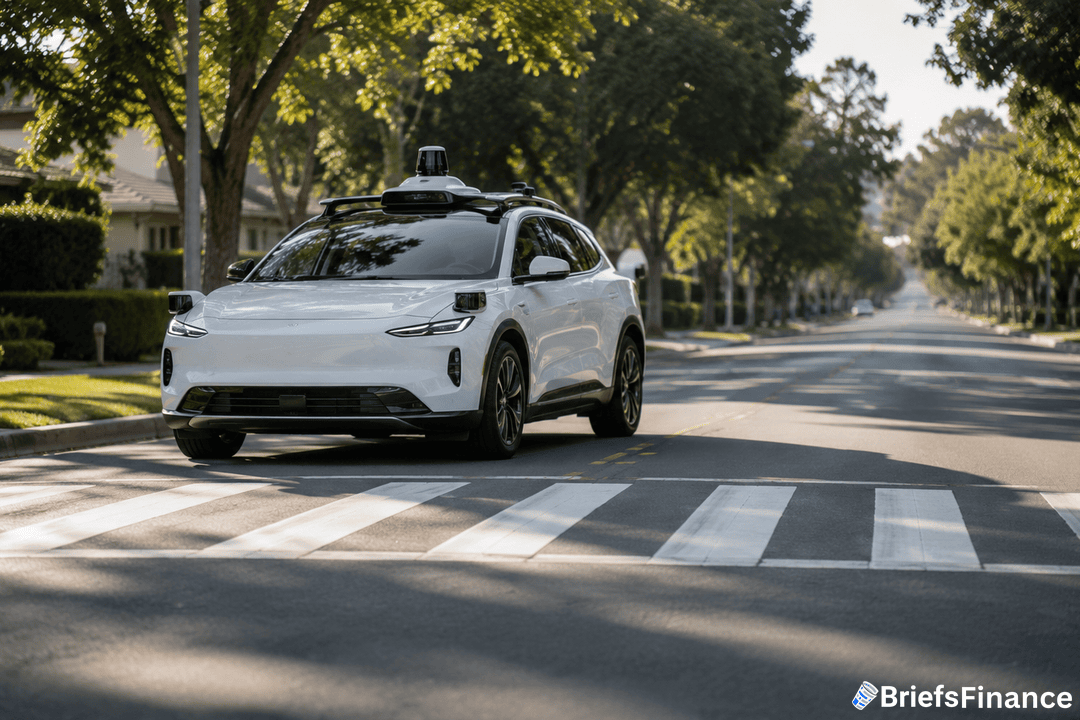
Waymo likes to say its robotaxis are safer than people. But how do you prove that?
You build a computer copy of a careful human. Then you ask what that driver would have done.
Waymo just rebuilt that copy from the ground up. The new one is sharper than the last.
The new tool is called the Reference Driver. Waymo built it with a team at TU Delft in the Netherlands.
They wrote up the work in the journal Nature Communications. The big change here is timing.
Older models only copied the last move. That meant the final swerve or the slam on the brakes.
The new one copies the whole run-up to a crash. It leans on an idea called active inference.
In plain terms, a careful driver keeps picturing what might happen next. Then the driver picks the safest path.
The model even copies the "surprise" a driver feels when things go wrong. That was hard to do at scale before, a TU Delft professor said.
The model can also copy many kinds of road users. That goes beyond just dodging a crash.
Picture the crash-test dummy carmakers have used for years. This is like a dummy that thinks, not just one that takes the hit.
Every morning, Market Briefs breaks down moves like this in plain English, in five minutes a day, plus a free investing masterclass when you sign up.
A good human yardstick is basic gear for any robotaxi maker. Without it, you can't grade how your cars handle a crash.
Regulators and insurers lean on this math too. It helps decide who was at fault in a crash.
This also lands at a touchy moment. In January, one of Waymo's self-driving cars hit a child near a school in Santa Monica.
Waymo leaned on its old model to defend the car. It said a sharp human would have hit the child at about 14 mph.
Its own car hit the child at just 6 mph. It had slowed from 17 mph first.
The child had minor injuries. Safety agencies are still looking into the crash.
So this model is not just a science paper. It's the ruler Waymo uses to judge its own cars.
Waymo is adding cars in more cities right now. That brings more eyes from regulators and the public.
It is also opening the new model's code to outside groups. They can teach, test, and publish with it, but not use it to make money.
The model can run across thousands of crash cases at once. The old way could not do that at scale.
That lets schools and rivals poke holes in it. Still, one question hangs over all of it.
A company growing fast across many cities is also building the ruler it gets graded by.
Letting outsiders check that math is the part worth watching.
Want the story behind the tech you keep reading about? Join 350,000+ investors at Market Briefs and get a free 45-minute investing course when you join.