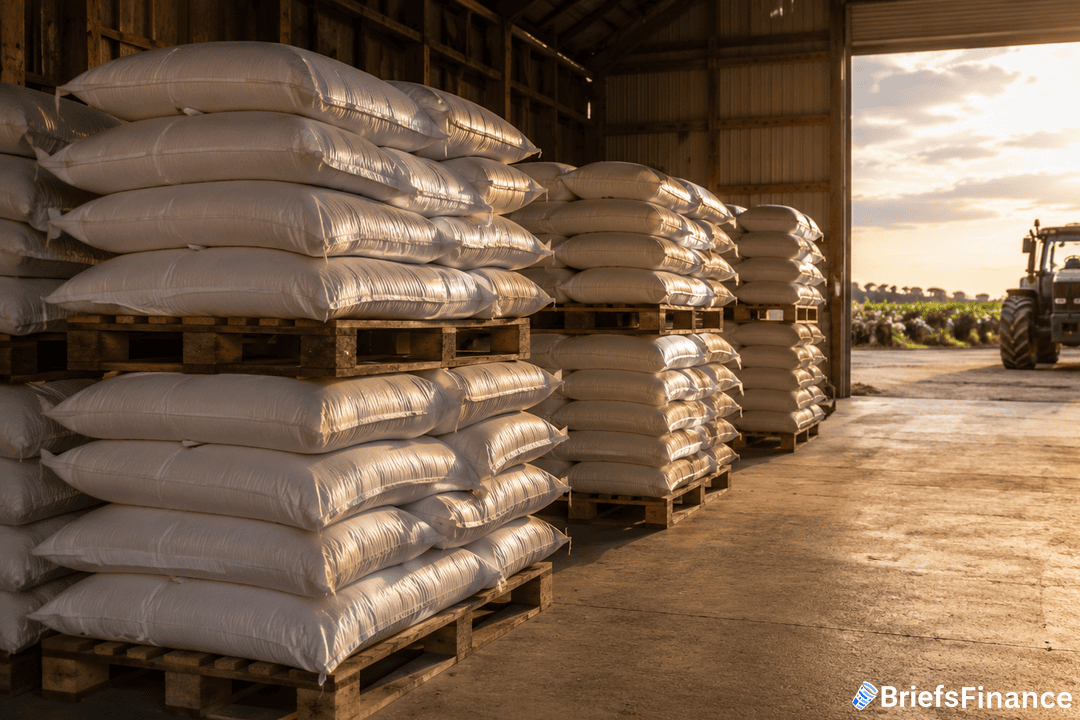
When the US‑Iran conflict flared up, fertilizer prices shot higher almost overnight. That gave farmers a strong reason to pause.
They had already stocked up on fertilizer before the tensions started. So instead of buying more at expensive prices, they decided to wait. "If farmers don't need fertilizer in the field immediately, they wait," said Svein Tore Holsether, chief executive at Yara International ASA, a major fertilizer producer.
Fertilizer prices are closely watched by global commodities markets because they directly influence crop yields and food costs. Yara, headquartered in Norway, is one of the world's largest fertilizer companies and often acts as an industry bellwether.
According to Holsether, the main cause of low European imports was farmers' pre-conflict stockpiling. With no urgent need, farmers held off through the end of the Northern Hemisphere growing season. By mid‑June, urea prices had dropped back to pre‑conflict levels.
Get the market news that matters in a five-minute read with Market Briefs, our free daily newsletter
Still, farmers stayed on the sidelines. "As prices started falling, they waited until they stabilized and until they were closer to actually needing the product," Holsether said.
On top of the price shock, shipping disruptions in the Strait of Hormuz made it harder to load cargoes and move product from the Persian Gulf. Major producers such as Saudi Basic Industries Corp, Fertiglobe Plc, and Qatar Fertiliser Co. operate in that area, meaning shipping disruptions there affect worldwide fertilizer availability.
Now the waiting game is ending. The Southern Hemisphere growing season is kicking off, especially in Brazil and Argentina, and farmers need fertilizer again. Holsether put it plainly: "There's a volume and price rebound right now."
The numbers back that up. European nitrogen imports were at historically low levels.
The growing season in the Southern Hemisphere, particularly in major agricultural exporters like Brazil and Argentina, significantly influences global fertilizer demand. As farmers in these regions prepare for planting, their purchasing decisions can shift global prices. Yara's CEO indicated that the company has observed a clear uptick in orders, signaling that the pause has ended.
"The next test is when and how do vessels come back into the Strait of Hormuz," Holsether said. That narrow waterway is a chokepoint for Persian Gulf fertilizer exports. Until shipping companies feel confident it is safe to transit, production from countries like Saudi Arabia, Qatar, and Bahrain faces uncertainty.
Holsether also noted the difficulty of seeing clearly right now. "It's very difficult to have a clear view of what is happening in terms of production in Iran, as one example," he said. There is also significant production from Qatar, Saudi Arabia, and Bahrain, but the lack of transparency makes it hard to gauge how much supply is actually reaching the market.
Join Market Briefs, our free daily newsletter, for a quick daily rundown of the markets